
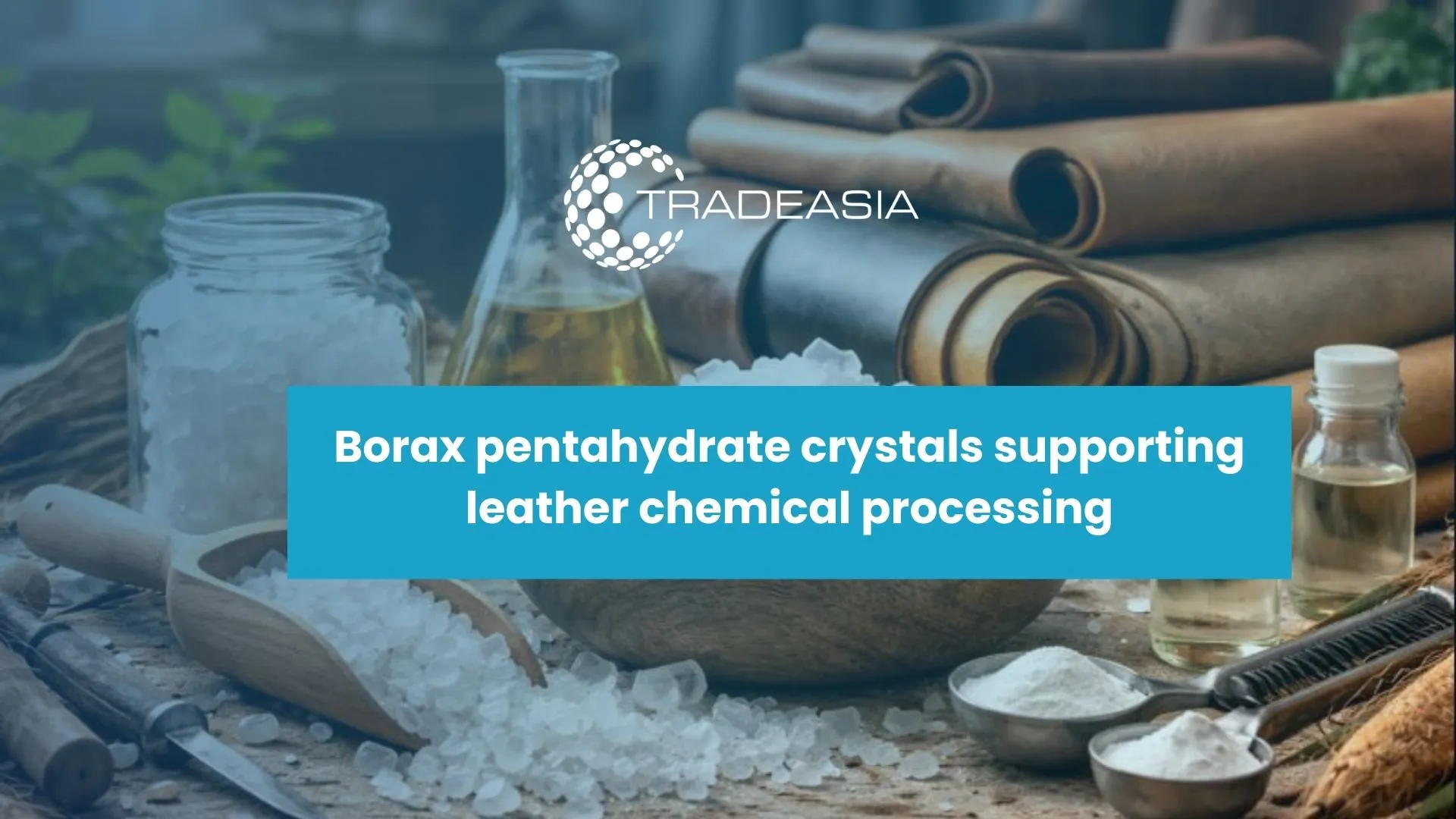
Introduction
The leather industry, a cornerstone of manufacturing across Asia, relies on a sophisticated array of chemicals to transform raw hides into durable, supple, and valuable materials. Among these essential compounds, Borax Pentahydrate (Sodium Tetraborate Pentahydrate, Na2B4O7·5H2O) holds a position of quiet yet critical importance. While not always in the spotlight, its multifaceted role in various stages of leather processing makes it an indispensable asset for tanneries aiming for quality, efficiency, and compliance.
This article delves into the specific applications, benefits, and market dynamics of Borax Pentahydrate within the Asian leather sector. As nations like China, India, Vietnam, and Bangladesh continue to dominate global leather production, understanding the chemicals that underpin this success is vital for industry stakeholders. We will explore how this versatile chemical functions, why it is preferred, and what trends are shaping its demand. Furthermore, we will provide insights into the supply chain, highlighting the role of established distributors and suppliers such as Chemtradeasia in ensuring a consistent and high-quality supply of essential leather chemicals to this dynamic region.
Understanding Borax Pentahydrate: Properties and Specifications
Borax Pentahydrate is a hydrated sodium borate salt, distinct from its more common decahydrate counterpart (Borax 10 Mol). Its chemical formula, Na2B4O7·5H2O, indicates it contains five molecules of water of crystallization. This difference in hydration level gives it unique physical properties that are advantageous in industrial applications. Typically appearing as a white, crystalline powder or granules, it is soluble in water and its solutions are alkaline. The pentahydrate form is often favored in processes where controlled alkalinity and buffering capacity are required, and where a higher concentration of active borate per unit weight is beneficial due to its lower water content.
Key specifications for industrial-grade Borax Pentahydrate used in leather processing include a minimum assay (as Na2B4O7·5H2O) of 99.5%, controlled particle size for consistent dissolution, and low levels of impurities such as heavy metals, which could interfere with subsequent dyeing and finishing processes. Its alkalinity (pH of a 1% solution is approximately 9.2) is a defining characteristic, making it an effective yet mild alkaline agent. This controlled basicity is crucial in leather processing, where pH swings must be managed carefully to avoid damaging the collagen structure of the hide.
When procuring Borax Pentahydrate, tanneries and chemical formulators must ensure the material meets consistent quality standards. Reputable suppliers like Chemtradeasia provide detailed technical data sheets (TDS) and material safety data sheets (MSDS), ensuring that customers receive a product with reliable specifications for their specific tanning and dyeing formulations. This reliability is non-negotiable in maintaining batch-to-batch consistency in leather production.
Key Applications in Leather Processing
The journey of leather from raw hide to finished product involves several chemical-intensive stages, and Borax Pentahydrate finds utility in multiple steps. Its primary function is as a pH buffer and a mild alkali. In the early beamhouse operations, after liming and deliming, the hide's pH needs to be carefully raised and stabilized before the tanning agents are introduced. Borax Pentahydrate is used in this "bating" or "pickling" stage to achieve a slightly acidic to neutral pH condition ideal for chrome tanning, the most common tanning method. It helps neutralize residual acids and creates a stable environment, ensuring the tanning agents penetrate evenly.
Another significant application is in the dyeing and fatliquoring stages. Leather dyeing is sensitive to pH, and Borax Pentahydrate serves as an excellent buffering agent to maintain the optimal pH range for dye fixation, resulting in uniform, vibrant, and fast colors. It prevents uneven dyeing or "patchiness" caused by pH fluctuations. Furthermore, in fatliquoring—where oils are emulsified and introduced to lubricate leather fibers—Borax can be used in the preparation of some anionic fatliquor emulsions, helping to stabilize the emulsion for better penetration and fiber coverage, ultimately yielding softer, more pliable leather.
Beyond these core processes, Borax Pentahydrate also finds use as a fire retardant treatment for specialty leathers and can act as a preservative in some leather auxiliary formulations due to its mild antifungal and antibacterial properties. Its versatility across the production chain, from preparation to finishing, underscores its value as a multi-purpose chemical in the tanner's arsenal.
Benefits of Using Borax Pentahydrate in Leather Production
The adoption of Borax Pentahydrate in leather manufacturing is driven by a compelling set of technical and economic benefits. Firstly, its buffering action is superior to many stronger alkalis. It allows for precise and gentle pH adjustment, which is critical for protecting the delicate hide substance. This controlled approach minimizes the risk of over-alkalization, which can lead to grain damage, brittleness, or uneven tanning, thereby enhancing the overall yield and quality of the leather.
Secondly, it contributes to improved process efficiency and product quality. By ensuring uniform dye uptake, it reduces the need for costly dye corrections or re-dyeing operations. In fatliquoring, its role in emulsion stability leads to better oil penetration and distribution, resulting in leather with superior tensile strength, tear resistance, and a consistent, desirable hand-feel. From an environmental and operational standpoint, Borax Pentahydrate is less corrosive than caustic soda or other strong alkalis, making it safer to handle and store, and reducing wear on equipment. It is also readily biodegradable under aerobic conditions, aligning with the increasing environmental compliance pressures faced by tanneries globally.
Finally, its multifunctionality offers cost-saving advantages. A single chemical that can buffer, mild-alkalize, assist in dyeing, and stabilize emulsions simplifies inventory management and can reduce the number of specialty chemicals required. For tanneries operating on thin margins, particularly in high-volume production hubs across Asia, this operational efficiency directly impacts the bottom line while maintaining, or even improving, leather quality.
The Asian Leather Chemicals Market: Trends and Insights
The Asian leather chemicals market is a dynamic and growing sector, intrinsically linked to the region's dominance in footwear, apparel, and upholstery manufacturing. Countries like China, India, and Vietnam are not only major producers of finished leather goods but also large consumers of processing chemicals. The market for auxiliaries like Borax Pentahydrate is influenced by several key trends. The first is the ongoing shift of leather production from the West to Asia, driven by cost advantages and robust supply chains. This migration continues to fuel demand for reliable, high-volume chemical supplies.
A second, powerful trend is the increasing emphasis on environmental sustainability. Governments in Asia are implementing stricter regulations on effluent discharge, particularly concerning chromium and other pollutants. This is pushing tanneries to adopt cleaner processes and chemicals. Borax Pentahydrate, with its lower environmental impact compared to harser alternatives, is well-positioned to benefit from this shift. Furthermore, the demand for higher-quality and specialty leathers (e.g., for automotive interiors or premium fashion) is rising. These segments require precise chemical control, further driving the need for consistent, high-purity buffering and auxiliary agents like Borax Pentahydrate.
Market analysis indicates steady growth in the leather chemicals sector in Asia, with a compound annual growth rate (CAGR) projected between 4-6% over the next five years. Price volatility of raw materials and the need for technological adaptation to meet eco-standards present challenges, but also opportunities for suppliers who can provide not just chemicals, but also technical support and sustainable solutions. The role of Borax Pentahydrate within this market remains secure due to its fundamental, hard-to-replace functions in the leather-making process.
Sourcing and Suppliers: Navigating the Asian Landscape
For tanneries and chemical distributors operating in Asia, sourcing reliable Borax Pentahydrate is a strategic decision. The supply landscape is diverse, featuring large-scale manufacturers, regional producers, and international trading companies. Key considerations when selecting a supplier include consistent product quality, reliable logistics and delivery networks, competitive pricing, and comprehensive technical support. Given the critical role this chemical plays in process stability, a disruption in supply or a batch with inconsistent specifications can lead to significant production losses.
This is where established chemical distributors and suppliers like Chemtradeasia add immense value. They act as vital intermediaries, connecting tanneries with reputable manufacturers and ensuring a smooth supply chain. A supplier such as Chemtradeasia typically offers more than just the product; they provide assurance through quality certifications, detailed documentation (TDS, MSDS, CoA), and logistical expertise crucial for navigating regional import/export regulations. They often maintain strategic stockpiles in key regions to ensure just-in-time delivery, reducing inventory holding costs for tanneries.
When evaluating suppliers, it is advisable to assess their track record, client portfolio, and ability to provide consistent specifications batch after batch. Partnering with a trusted supplier mitigates risk and allows tanneries to focus on their core manufacturing competencies. For businesses looking to source Borax Pentahydrate or other leather chemicals in Asia, engaging with a proven partner in the chemical distribution network is a step toward securing operational resilience and product quality.
Conclusion
Borax Pentahydrate exemplifies how a seemingly simple inorganic compound can be a linchpin in a complex industrial process like leather manufacturing. Its roles as a pH buffer, dyeing assistant, and emulsion stabilizer are integral to producing high-quality leather efficiently and with greater environmental consideration. As the Asian leather industry continues to evolve under the pressures of global demand, quality expectations, and environmental regulations, the importance of reliable, high-performance chemicals will only increase.
Understanding the specifications, applications, and benefits of Borax Pentahydrate empowers tanneries to optimize their processes. Simultaneously, navigating the supply landscape with insight, leveraging the services of dependable suppliers and distributors, ensures that this essential chemical is available when and where it is needed. For stakeholders across Asia's vast leather sector, from chemical formulators to finished goods producers, a deep knowledge of workhorse chemicals like Borax Pentahydrate is not just technical detail; it is a foundation for sustainable competitiveness and growth in the global marketplace. To ensure consistent quality, regulatory compliance, and a reliable supply of Borax Pentahydrate for your leather processing needs in Asia, connect with Chemtradeasia through their contact page and speak directly with their chemical supply experts.