Introduction
The global trade in soybean oil continues to expand as food manufacturers, biodiesel producers, and industrial users seek reliable, sustainable vegetable oil sources. Between 2020 and 2024, soybean oil remained one of the top three traded vegetable oils worldwide, alongside palm and sunflower oil, with major exporters such as Brazil, the United States, and Argentina supplying key import hubs in Asia, the Middle East, and Europe. As we move into Q2 2026, exporters face a more complex regulatory environment shaped by food safety laws, sustainability requirements, and tightening trade controls.
For companies shipping soybean oil in bulk or packaged form, export compliance is no longer just a legal obligation; it is a strategic differentiator. Buyers increasingly demand proof of origin, traceability, and conformity with destination-country standards. Failure to comply can result in shipment delays, rejections at port, financial penalties, or long-term reputational damage. A structured, up-to-date export compliance checklist is therefore essential for any organization that wants to scale its soybean oil business globally.
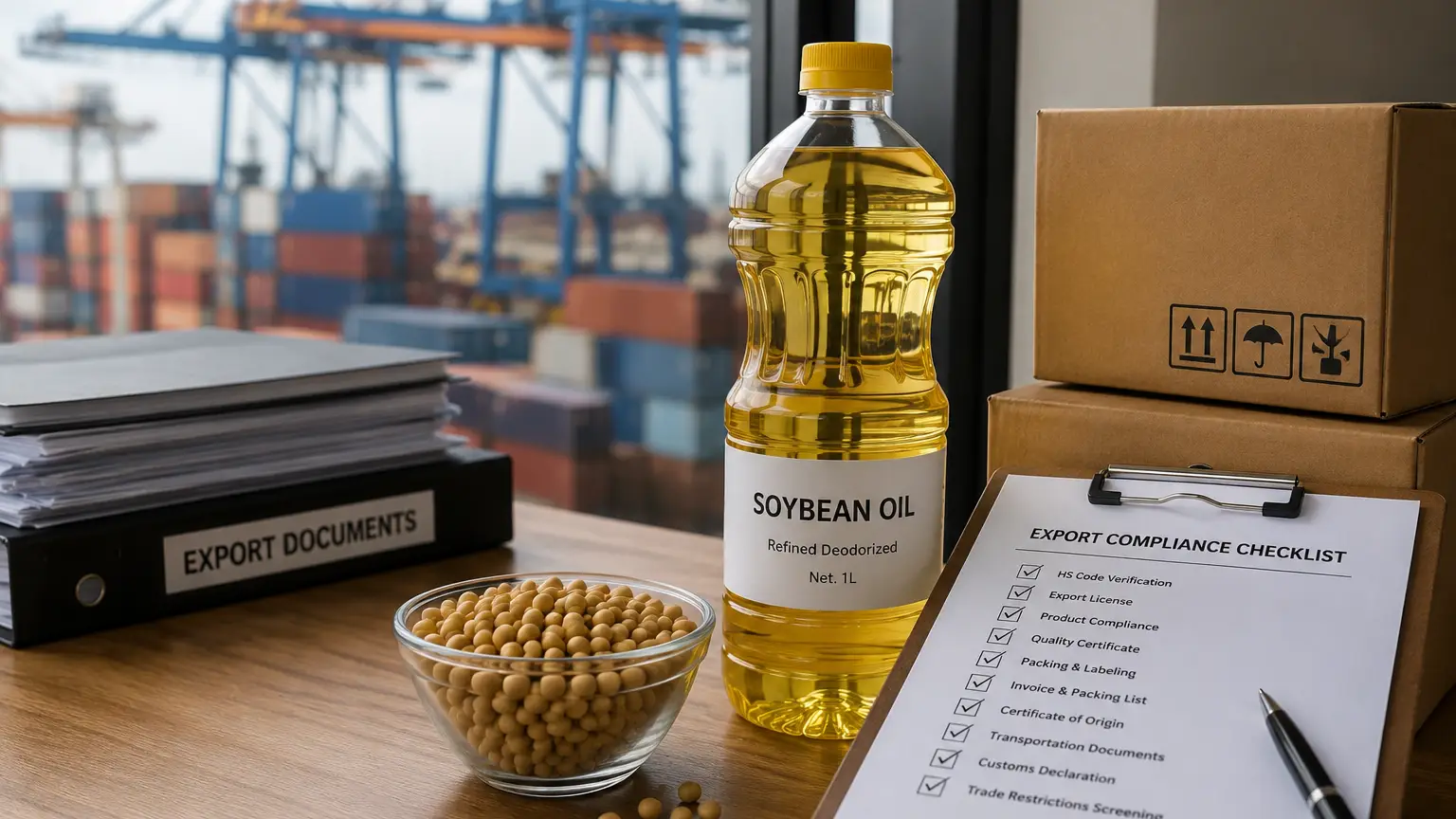
This article presents a detailed, practical export compliance checklist for soybean oil in Q2 2026, tailored for suppliers, traders, and distributors serving multiple regions. It integrates market insights, regulatory trends, and product-specific requirements, while highlighting how digital platforms such as chemtradeasia.com, chemtradeasia.in, chemtradeasia.co.id, chemtradeasia.ae, and chemtradeasia.sg can support documentation, quality verification, and risk management across global supply chains.
Global Market Outlook for Soybean Oil in Q2 2026
In Q2 2026, the soybean oil market is shaped by several macro trends: shifting planting patterns in South America and the U.S., continued demand from Asian food processors, and policy-driven demand from the biofuel sector. Over the last few years, global soybean oil production has typically hovered around 60–65 million metric tons annually, with modest growth driven by both food and industrial applications. While exact 2026 figures will depend on weather and policy, most analysts expect steady demand growth in the 2–3% range, with tight margins and heightened scrutiny on sustainability and deforestation risks.
Asia remains the primary demand center, with China, India, and Southeast Asian countries importing large volumes of crude and refined soybean oil for consumer-packaged foods, frying applications, and foodservice. India, for example, has consistently ranked among the world’s largest vegetable oil importers, relying on imports to meet more than half of its domestic demand. This dynamic creates opportunities for exporters who can meet India’s Food Safety and Standards Authority (FSSAI) rules, labeling requirements, and evolving health regulations regarding trans fats and contaminants.
At the same time, the Middle East and North Africa (MENA) region is increasing its imports of soybean oil for both food and industrial uses, while Europe’s demand is being shaped by sustainability regulations and the Renewable Energy Directive’s criteria for biofuels. These trends mean exporters must not only track price and freight volatility but also ensure that their soybean oil products comply with a patchwork of national and regional standards. Leveraging regional hubs and online platforms such as chemtradeasia.ae for the Middle East, chemtradeasia.co.id for Indonesia, and chemtradeasia.sg for Southeast Asia can help align product specifications and logistics with local market expectations.
Core Regulatory Frameworks Governing Soybean Oil Exports
Exporters of soybean oil must navigate a multi-layered regulatory environment that spans international guidelines, origin-country export laws, and destination-country food and customs regulations. At the international level, the Codex Alimentarius Commission provides key reference standards for edible fats and oils, including limits on contaminants such as aflatoxins, pesticide residues, and process contaminants like 3-MCPD and glycidyl esters. While Codex standards are voluntary, many countries align their national regulations with these benchmarks, making them a practical starting point for compliance planning.
Origin-country requirements usually focus on export licensing, sanitary and phytosanitary (SPS) measures, and documentation. Exporters from major producing countries often need health certificates issued by competent authorities, confirmation that the soybean oil is fit for human consumption, and sometimes non-GMO or GMO declarations depending on the destination. For example, shipments to the European Union may require documentation demonstrating compliance with EU regulations on genetically modified organisms, maximum residue levels (MRLs) for pesticides, and contaminant thresholds set by the European Food Safety Authority (EFSA).
Destination-country rules are often the most complex and commercially sensitive. In India, the FSSAI sets quality parameters, labeling requirements, and packaging standards for edible oils, including soybean oil. In Gulf Cooperation Council (GCC) countries, Gulf Standards Organization (GSO) norms govern edible oil quality, shelf life, and labeling. Meanwhile, importers in China must comply with the National Food Safety Standards (GB standards), which define quality indicators, sensory requirements, and permissible additives. Exporters must systematically identify the specific regulations applicable to each target market and ensure that their soybean oil grades, packaging, and documentation align with those requirements before shipment.
Product Specifications and Quality Standards for Soybean Oil
Understanding and controlling product specifications is at the heart of export compliance for soybean oil. International buyers typically distinguish between crude soybean oil and refined, bleached, and deodorized (RBD) soybean oil. Crude soybean oil is often used as a feedstock for further refining or biodiesel production, while RBD soybean oil is intended for direct use in food applications. Key quality parameters include free fatty acid (FFA) content, moisture and impurities, color, peroxide value, and odor. For food-grade RBD soybean oil, many markets expect FFA levels below 0.1–0.2% (as oleic acid), low peroxide values, and a bland, neutral taste and smell.
Exporters should implement robust quality management systems, including HACCP and, where relevant, ISO 22000 or FSSC 22000 certifications, to demonstrate consistent control over these parameters. Regular laboratory testing, either in-house or through accredited third-party labs, is essential to verify conformity with buyer specifications and regulatory limits. For example, some markets may impose stricter limits on polycyclic aromatic hydrocarbons (PAHs) or process contaminants, requiring more advanced refining and monitoring. Maintaining a detailed specification sheet and Certificate of Analysis (CoA) for each batch is a standard expectation for international buyers.
Product differentiation and traceability are increasingly important, especially as sustainability and health concerns gain prominence. Some buyers may request non-GMO soybean oil, identity-preserved supply chains, or certification under schemes such as RSPO-equivalent frameworks for soy, or deforestation-free commitments. Platforms like chemtradeasia.com and regional sites such as chemtradeasia.in and chemtradeasia.sg typically provide detailed product data sheets, typical specifications, and safety documentation for refined soybean oil and related products. Exporters can use these resources as benchmarks when aligning their own product offerings with international expectations.
Documentation, Logistics, and Digital Compliance with Tradeasia Platforms
Accurate and complete documentation is a critical pillar of soybean oil export compliance. At a minimum, exporters should prepare commercial invoices, packing lists, bills of lading, and certificates of origin. For edible soybean oil, additional documents often include health or sanitary certificates, phytosanitary certificates (where required), quality certificates or CoAs, and insurance documents. In some jurisdictions, halal certification is required for food products destined for Muslim-majority markets, and kosher certification may be requested by specific buyers. Ensuring that all documents are consistent—especially product descriptions, HS codes, net weights, and batch numbers—helps avoid customs delays and disputes.
Logistics planning must account for the physical properties and shelf life of soybean oil. Bulk shipments are commonly transported in flexitanks, ISO tanks, or dedicated oil tankers, while smaller volumes may be exported in drums, intermediate bulk containers (IBCs), or consumer packaging. Exporters must ensure that containers are food-grade, properly cleaned, and compatible with soybean oil to prevent contamination or quality degradation. Temperature control, protection from light and oxygen, and appropriate use of nitrogen blanketing can extend shelf life and preserve quality, which is particularly important for long-distance shipments from South America or Asia to Europe and Africa.
Digital trade platforms operated by Tradeasia, including chemtradeasia.com, chemtradeasia.in, chemtradeasia.co.id, chemtradeasia.ae, and chemtradeasia.sg, play an increasingly important role in simplifying documentation and compliance workflows. These platforms typically centralize product specifications, safety data sheets (SDS), and standard documentation templates, enabling exporters and buyers to align on requirements early in the transaction. Integrated communication tools help clarify regulatory needs by destination country, while digital record-keeping supports traceability and audit readiness. By leveraging such platforms, exporters can reduce errors, accelerate document preparation, and maintain a consistent compliance trail across multiple markets.
Conclusion
Exporting soybean oil in Q2 2026 requires more than competitive pricing and reliable supply; it demands a disciplined approach to regulatory compliance, product quality, and documentation. Global market dynamics, from growing demand in Asia and MENA to evolving sustainability expectations in Europe, create both opportunities and compliance challenges for producers and traders. A structured checklist that covers regulatory mapping, product specification control, quality management, documentation, and logistics planning can significantly reduce the risk of shipment delays, rejections, or reputational harm.
By aligning their internal systems with international standards and destination-country rules, exporters can build trust with buyers and differentiate themselves in a crowded marketplace. Partnering with experienced intermediaries and leveraging digital platforms such as chemtradeasia.com, chemtradeasia.in, chemtradeasia.co.id, chemtradeasia.ae, and chemtradeasia.sg can further streamline compliance, provide access to up-to-date product documentation, and support smooth cross-border transactions. As regulations continue to evolve, proactive monitoring, regular training, and close collaboration with supply chain partners will remain essential components of a resilient soybean oil export strategy.
This article is intended solely for informational and market insight purposes and does not constitute technical, safety, legal, or other professional advice. Readers should independently verify all requirements with qualified experts, consult official standards and documentation such as MSDS/SDS and regulatory texts, and, where appropriate, contact their compliance advisors or our team for guidance on specific products, markets, or applications.
Leave a Comment