
Introduction: Technical Precision in Dim Sum Production
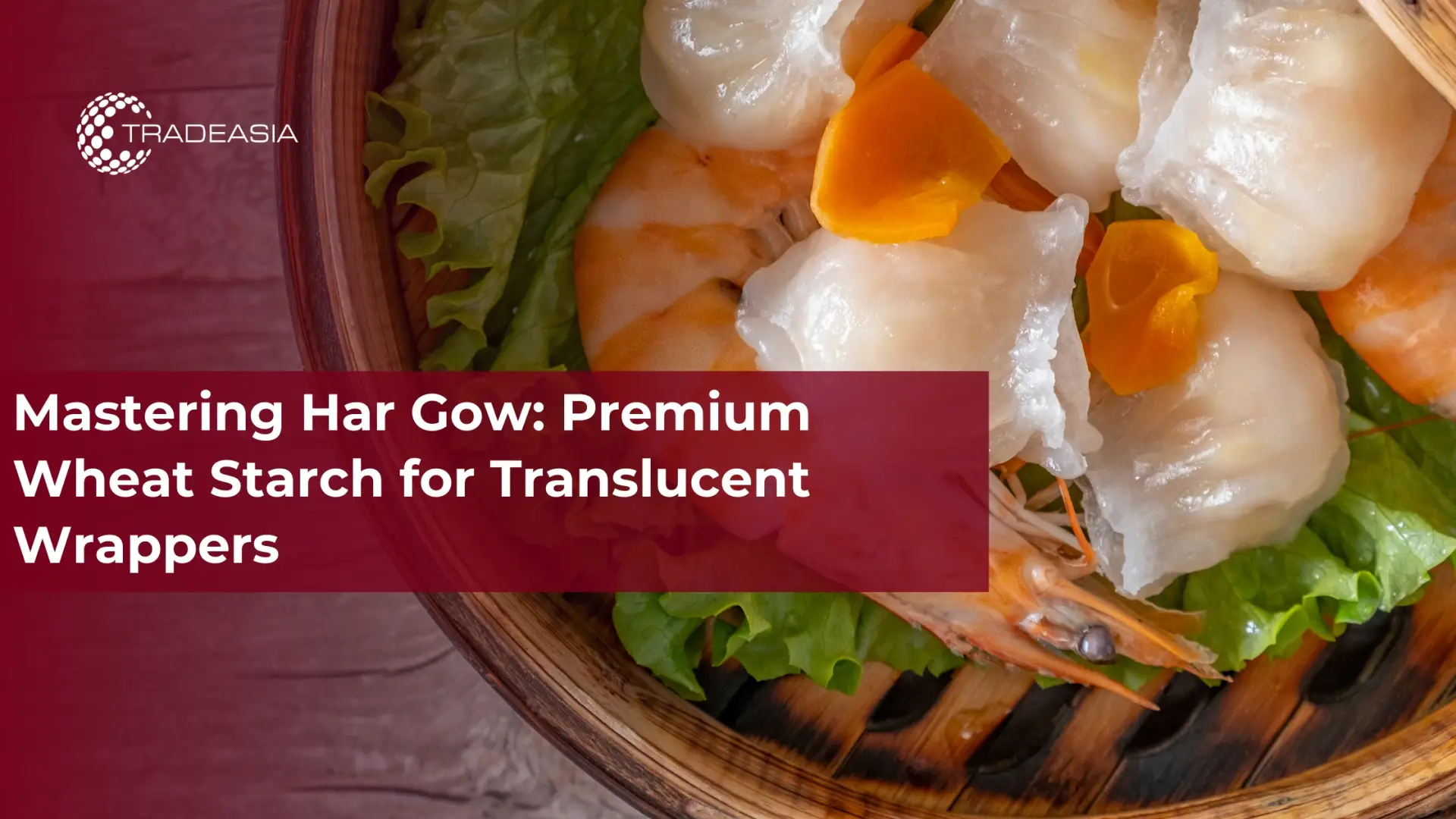
Har Gow, the traditional Cantonese shrimp dumpling, is widely regarded as one of the most technically refined products in the dim sum category. Its defining characteristic is the thin, translucent wrapper that reveals the shrimp filling while maintaining structural integrity and a delicate, elastic bite. In commercial production environments—ranging from centralized commissaries to large-scale frozen food manufacturers—the wrapper presents a unique formulation and processing challenge.
Unlike wheat-based dough systems used in bread, noodles, or pastries, Har Gow wrappers rely on a starch-dominant matrix rather than gluten development. Conventional wheat flour contains significant levels of gluten-forming proteins, primarily gliadin and glutenin. When hydrated and mechanically worked, these proteins form a cohesive gluten network that produces elasticity and opacity. While advantageous in many bakery applications, gluten formation is undesirable for Har Gow because it reduces translucency and produces a firmer, more opaque texture.
To achieve the required clarity and tenderness, manufacturers utilize highly refined native wheat starch with minimal residual protein. The starch becomes the structural foundation of the wrapper system, often combined with complementary starches to balance elasticity and handling performance. For food manufacturers and procurement professionals, understanding the functional behavior of wheat starch is essential for optimizing production efficiency, maintaining consistent quality, and ensuring reliable supply across fresh and frozen product formats.
The Functional Basis of Translucency
The hallmark translucency of Har Gow wrappers is fundamentally a result of starch gelatinization in a low-protein environment. During industrial starch extraction, wheat flour undergoes wet milling processes that separate starch granules from gluten proteins and other insoluble components. The resulting refined wheat starch typically contains a residual protein level well below that of standard flour, allowing it to form a relatively clear gel when properly hydrated and heated.
Wheat starch is composed primarily of two glucose polymers: amylose and amylopectin. In native wheat starch, amylose generally represents approximately 25–28% of the total starch content, while amylopectin accounts for the remaining 72–75%. This ratio is relatively consistent across conventional wheat varieties and contributes to the starch’s characteristic gelatinization and setting behavior.
When boiling water is added during dough preparation, the starch granules undergo rapid gelatinization. At temperatures typically above 55–65°C, the crystalline regions within the granules begin to disrupt. Water penetrates the structure, the granules swell, and amylose molecules leach into the surrounding matrix. As the system transitions from a particulate suspension to a continuous gel phase, light transmission increases due to the absence of gluten networks and the formation of a relatively uniform gel matrix.
However, translucency is influenced by more than polymer composition alone. Residual protein, ash content (which reflects mineral presence), particle size distribution, and degree of hydration all affect optical clarity. Inconsistent mixing can introduce micro-voids or uneven gelatinization zones, reducing transparency. Additionally, wrapper thickness plays a significant role; even a well-formulated starch system may appear opaque if sheeted too thickly. Therefore, raw material quality and process control must work in tandem to achieve consistent visual performance.
Rheological Performance in Dough Handling
While translucency defines the product visually, rheological behavior determines its manufacturability and eating quality. Har Gow dough must be sufficiently extensible to be rolled into thin sheets and pleated without tearing, yet firm enough after steaming to deliver a clean, elastic bite rather than a sticky or pasty texture.
Native wheat starch, by itself, forms a gel-like system but lacks the elastic recovery associated with gluten-containing doughs. To compensate for this limitation, most commercial formulations incorporate tapioca starch. Tapioca starch, derived from cassava, is known for its high amylopectin content and strong elasticity after gelatinization. In combination, wheat starch provides structure and translucency, while tapioca starch enhances flexibility and reduces brittleness during forming.
The ratio between these starches is critical. Excessive wheat starch may produce a firm but less extensible dough, increasing the risk of tearing during pleating. Excessive tapioca starch may improve stretchability but reduce clarity or structural firmness after steaming. Manufacturers typically determine optimal ratios through pilot-scale trials and rheological testing, balancing sheetability, pleat retention, and final mouthfeel.
Retrogradation—the process by which gelatinized starch molecules reassociate during cooling—also plays a role in texture development. Wheat starch exhibits moderate retrogradation behavior due to its amylose content. Controlled retrogradation contributes to structure setting and helps the wrapper maintain shape after steaming. However, excessive retrogradation during storage can lead to firmness or dryness. Managing cooling rates and moisture content helps mitigate these effects and maintain the desired “Q” texture often associated with high-quality dim sum products.
Process Control: Hydration, Mixing, and Sheeting Variables
In industrial production, consistent wrapper performance depends heavily on process control. Hydration is particularly critical. The water-to-starch ratio determines not only dough consistency but also gelatinization completeness and final translucency. Insufficient water can result in incomplete granule swelling and uneven texture, while excessive water may weaken the gel matrix and reduce mechanical strength.
The method of water incorporation is equally important. Har Gow dough preparation traditionally involves adding boiling water directly to the starch blend. This high-temperature hydration initiates rapid gelatinization and partial setting before mechanical handling begins. In automated systems, precise temperature control ensures uniform thermal input, minimizing variability between batches.
Mixing intensity and duration influence granule dispersion and gel uniformity. Under-mixing can create localized dry pockets or agglomerates, leading to weak spots in the wrapper. Over-mixing, while less damaging than in gluten systems, may still affect temperature distribution and moisture loss. Consistent mixing parameters are therefore essential in high-speed production lines.
Sheeting thickness and forming pressure must also be standardized. Thin, uniform sheets promote translucency and even steaming, whereas thickness variation can cause differential cooking and structural inconsistency. In automated pleating systems, dough extensibility must remain within a defined range to prevent tearing or deformation.
Thermal Processing and Freeze–Thaw Considerations
Steaming represents the primary cooking method for Har Gow. In atmospheric steamers, temperatures approach 100°C under saturated humidity conditions. During this stage, any remaining ungelatinized starch completes its transformation, and the gel matrix sets into a cohesive film. Properly refined wheat starch supports predictable gelatinization within this temperature range, contributing to stable structure formation.
After steaming, the wrapper must retain integrity while enclosing a moisture-rich filling. Water migration between filling and wrapper can influence texture and clarity. A well-formulated starch system helps maintain a balanced moisture gradient, preventing excessive softening or surface stickiness.
In frozen product formats, additional factors emerge. Freezing induces ice crystal formation within the hydrated gel matrix. Native wheat starch does not inherently provide strong freeze–thaw stability; ice crystals can disrupt the gel network, potentially leading to syneresis (water release) upon thawing. To address this, manufacturers often rely on optimized starch blends and controlled freezing rates rather than depending solely on wheat starch performance.
Rapid blast freezing tends to produce smaller ice crystals, reducing structural damage. During reheating, careful steam control helps restore the wrapper’s elasticity and translucency. When formulation and processing are aligned, the final reheated product can closely resemble freshly prepared dumplings in both appearance and texture.
Quality Specifications and Analytical Parameters
For procurement and quality assurance teams, defining clear analytical parameters is essential. Key specifications for wheat starch in Har Gow applications typically include moisture content, residual protein level, ash content, particle size distribution, and microbiological limits.
Moisture content affects storage stability and hydration consistency. Excess moisture can promote microbial growth and alter water absorption behavior. Residual protein levels influence optical clarity; lower levels generally support improved translucency. Ash content reflects mineral impurities and may affect color and gel uniformity.
Particle size distribution influences hydration kinetics and mixing behavior. Uniform granules promote consistent swelling and reduce the risk of agglomeration. Some manufacturers also assess pasting properties using rapid visco analysis (RVA) to evaluate gelatinization temperature and viscosity development.
Microbiological standards must be clearly defined. As an agricultural derivative processed via wet milling, wheat starch must be manufactured under strict hygiene controls. Acceptable limits for aerobic plate count, yeast and mold, coliforms, and absence of key pathogens should be validated through Certificates of Analysis. Although the final product undergoes thermal processing, starting with low microbial loads supports overall food safety management.
Procurement Standards: Supplier Qualification and Risk Management
Selecting a wheat starch supplier for commercial dim sum production requires evaluating both technical and operational criteria. Beyond basic specification compliance, suppliers should demonstrate consistent lot-to-lot quality and robust quality management systems.
Certification under recognized food safety schemes, such as HACCP-based systems aligned with Global Food Safety Initiative standards, provides assurance of controlled processing environments. Traceability systems should enable raw material origin tracking and rapid documentation retrieval.
Supply reliability is another critical factor. Wheat starch availability may be influenced by agricultural yield variability, regional milling capacity, and logistical conditions. Working with suppliers that maintain diversified sourcing strategies and structured inventory planning can reduce exposure to seasonal or geopolitical disruptions.
Technical support also adds value. Suppliers capable of providing formulation guidance, application testing data, and rapid troubleshooting assistance contribute to long-term process optimization. For high-volume manufacturers, collaborative relationships with ingredient suppliers can improve efficiency and reduce development timelines.
Conclusion
The production of high-quality Har Gow wrappers is a technically precise process that depends on a carefully designed starch system. Refined native wheat starch plays a central role in achieving translucency and structural firmness, while complementary starches enhance extensibility and handling properties. Consistent hydration, controlled gelatinization, and well-managed thermal processing are essential to translating ingredient functionality into reliable manufacturing performance.
For food manufacturers, sourcing premium wheat starch involves evaluating purity, analytical specifications, microbiological control, and supplier reliability. A disciplined procurement strategy aligned with technical requirements ensures stable production, predictable texture, and consistent visual quality across fresh and frozen product formats.
Partner with Food Additives Asia for Ingredient Security
At Food Additives Asia, we supply high-purity Native Wheat Starch developed to meet the functional requirements of commercial dumpling and frozen food applications. Our products are sourced from audited manufacturers with controlled refinement processes, ensuring low residual protein, consistent moisture levels, and reliable particle characteristics.
We support manufacturers with comprehensive technical documentation, application guidance, and dependable regional distribution. To obtain detailed specifications and structured sourcing solutions, contact our corporate distribution team at foodadditivesasia.com.