
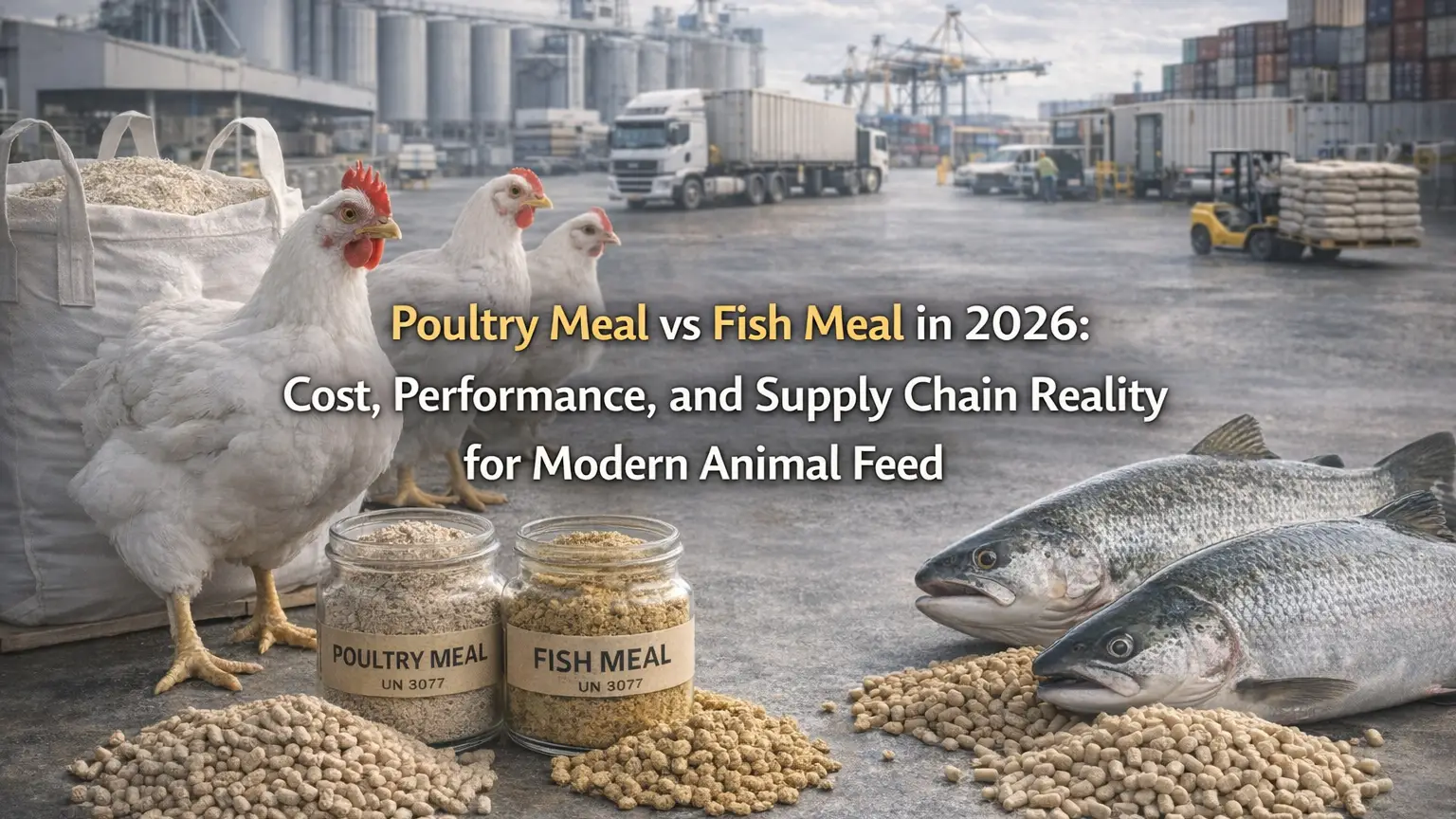
In 2026, feed producers are balancing three pressures at the same time: higher formulation costs, more frequent supply disruptions, and stricter sustainability expectations from customers and regulators. Poultry meal and fish meal both remain important animal proteins, but their roles are separating. Poultry meal is increasingly treated as a stable baseline protein for cost control, while fish meal is used more selectively for performance-critical diets, especially in aquaculture.
This article compares poultry meal and fish meal through a 2026 lens: nutrition and performance, true cost efficiency, availability, logistics risk, and sustainability and compliance factors. The aim is to support procurement and formulation teams who need practical guidance for modern feed programs.
What Poultry Meal and Fish Meal Deliver Nutritionally
Poultry meal
Poultry meal comes from rendered poultry by-products such as frames, heads, feet, organs, and trimmings generated by processing plants. After cooking, drying, and grinding, it becomes a stable protein ingredient for feed use.
Typical commercial poultry meal is often positioned as a high-protein ingredient with meaningful amino acids for monogastric animals. In real-world buying, the biggest variable is not the concept of poultry meal, but the consistency of raw material inputs and rendering conditions. That variability impacts digestibility, fat content, ash, and amino acid availability, which is why quality assurance matters as much as price.
Poultry meal is common in broiler grower and finisher diets, swine diets, pet food, and some aquaculture formulations where fish meal inclusion is being reduced for cost reasons.
Fish meal
Fish meal is produced from small pelagic fish (such as anchovy and sardine) and also from fish processing by-products. It is valued for high digestibility, a favorable amino acid balance, and functional benefits in palatability. It also contributes minerals such as phosphorus and calcium, and depending on the source and processing, can support performance during early life stages when feed intake and nutrient absorption are decisive.
Fish meal remains a key input in aquaculture, especially for salmonids, shrimp, and marine species where palatability and digestible protein quality translate directly into survival, growth, and feed conversion.
Cost Reality in 2026: Why Price per Tonne Misleads Buyers
Poultry meal cost drivers
Poultry meal pricing is linked to poultry processing volumes, rendering capacity, competition from pet food, and local demand from livestock and aqua feed. Compared with marine proteins, poultry meal typically benefits from steadier production because poultry processing runs year-round and is geographically diversified. Rising poultry meat production also supports a more resilient raw material base.
For procurement teams, the main risks sit in quality spread between suppliers, plus regional constraints where rendering infrastructure is limited. In those markets, local shortages can push prices up even when global protein markets soften.
Fish meal cost drivers and volatility
Fish meal pricing remains structurally more volatile because supply depends on fisheries, quotas, and ocean conditions. Peru is central to global fish meal supply in average years, and quota decisions in Peru’s north-central region can quickly tighten or loosen the market.
Recent quota adjustments and market commentary show how quickly conditions shift. Reports in late 2025 highlighted fish meal price increases alongside changing quota expectations, reinforcing how policy and biological surveys can influence pricing momentum.
IFFO reporting also indicates that fish meal supply can swing materially year to year depending on landings and regional output, which adds uncertainty to forward procurement planning.
The practical metric: cost per unit of digestible value
Many feed mills already calculate value on digestible amino acids, not on headline price per tonne. This is where fish meal can justify a premium in high-performance applications. Higher digestibility and stronger palatability can improve feed intake and feed conversion, which matters most in starter diets and species with tight biological margins.
Poultry meal can still win economically when formulation targets are met through careful supplier selection, consistent specs, and amino acid balancing. The business case is strongest when the diet is cost-driven and the performance sensitivity is lower.
Performance in Poultry, Swine, and Aquaculture
Digestibility and amino acid reliability
Fish meal is widely treated as a benchmark because of its digestibility and amino acid balance, especially for aquatic species. Poultry meal performance depends heavily on rendering quality and raw material consistency. The gap often narrows in poultry and swine diets, particularly in grower and finisher phases where formulation flexibility is higher and synthetic amino acids are commonly used to fine-tune the profile.
For buyers, the decision is rarely “fish meal or poultry meal.” The decision is “which specs and which inclusion level deliver the required outcome at the lowest risk.”
Palatability and functional benefits
Fish meal has a clear advantage in palatability, which is why it remains difficult to remove entirely from some aquaculture feeds. In early growth stages, palatability influences feed intake, which can determine survival and growth trajectories.
Poultry meal typically delivers neutral to acceptable palatability in many livestock feeds. In aquaculture, performance depends on species, inclusion level, and the rest of the formula. Some operations use attractants and blended protein strategies to reduce fish meal inclusion without losing intake performance.
Replacement logic that works in 2026
Across many commercial formulations, poultry meal can replace part of fish meal when the goal is cost control and supply stability. Fish meal tends to remain “protected” in formulations where performance penalties are expensive, such as shrimp, salmonids, or sensitive early-stage feeds.
A practical approach for 2026 is to treat fish meal as a targeted tool, not a bulk protein. Reserve it for roles where it changes animal outcomes, then use poultry meal and other proteins to build the rest of the cost-efficient matrix.
Supply Chain and Logistics Reality for 2026
Poultry meal: shorter, more controllable supply chains
Poultry meal typically benefits from regional production networks, especially in countries with large poultry industries. Shorter lead times, more supplier options, and simpler inland logistics reduce disruption risk. Storage is manageable under standard dry conditions, assuming moisture and shelf-life controls are in place.
Fish meal: import dependency and ocean-linked risk
Fish meal is more exposed to long-distance sea freight, port congestion, seasonal availability, and quota-driven market swings. This matters for import-dependent markets where lead times can extend and buyers may face sudden price shifts linked to quota announcements and landing data.
The risk is not only “will fish meal be available,” but also “will it be available at the spec and timing required to protect animal performance.” That is why many feed companies in 2026 use more forward contracting and maintain stricter supplier qualification programs.
Sustainability and Compliance: What Buyers Are Being Asked to Prove
Sustainability scrutiny is rising across animal protein supply chains, including feed inputs. Fish meal faces ongoing attention linked to forage fish management and responsible sourcing. Poultry meal often aligns with circular economy narratives because it valorizes by-products that would otherwise become waste, though buyers still need traceability and consistent quality controls.
In practical procurement, the 2026 expectation is documentation readiness:
- clear product specifications and consistent CoA parameters
- traceability of origin and processing
- supplier statements on sustainability practices where required by customers
For fish meal, responsible sourcing programs and supply transparency increasingly support market access. For poultry meal, rendering standards, contamination controls, and consistent nutritional specs often drive qualification decisions.
What to Choose in 2026: A Buyer-Focused Decision Guide
Poultry meal is usually the stronger choice when:
- the formulation is cost-sensitive and produced at scale
- the species and phase allow flexibility in protein sources
- supply stability and shorter lead times reduce operational risk
- the buyer has strong QA controls to manage variability
Fish meal remains the better choice when:
- palatability and digestible protein quality directly protect ROI
- the diet targets early life stages or demanding aquaculture species
- performance losses would cost more than the ingredient premium
Most modern feed strategies sit in the middle: blended protein systems that combine poultry meal and fish meal, supported by plant concentrates, amino acid supplementation, and in some cases alternative proteins. This reduces exposure to any single commodity shock while keeping performance within target.
Conclusion
In 2026, poultry meal and fish meal play complementary roles. Poultry meal supports cost control and supply continuity, especially for poultry and swine feeds and for cost-optimized aquaculture diets. Fish meal remains a premium performance tool, with volatility shaped by quotas, landings, and ocean conditions that can shift quickly.
If you are reviewing protein sourcing for 2026 feed programs, the strongest results usually come from tight specs, disciplined supplier qualification, and a diversified procurement plan.
Chemtradeasia can support your procurement team with buyer-ready specifications, documentation support, and regional sourcing options for animal protein ingredients, including poultry meal and fish meal. If you want to benchmark your current supply against alternative origins, specs, or delivery models, you can reach out to Chemtradeasia to discuss available grades and sourcing routes that match your formulation and logistics needs.