
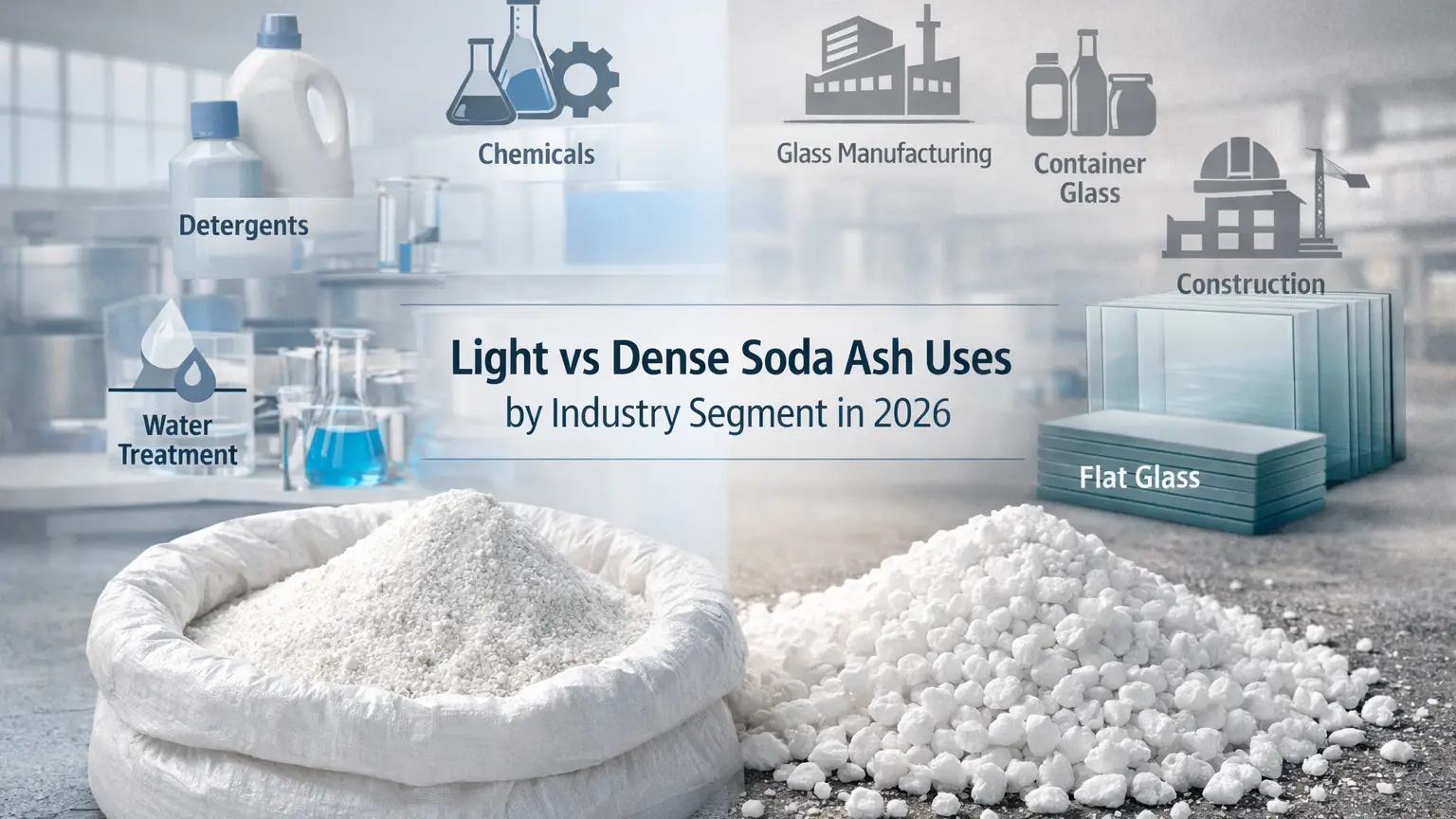
Soda ash, also known as sodium carbonate, remains one of the most widely used alkalis in global manufacturing. In 2026, choosing between light soda ash and dense soda ash is no longer a simple specification decision. The grade selected directly affects process efficiency, handling costs, energy consumption, and final product quality across industries such as glass, detergents, chemicals, water treatment, and textiles.
Understanding how each grade performs in real industrial conditions helps buyers reduce total cost of use rather than focusing only on price per ton.
Why Soda Ash Grade Selection Matters in 2026
Global soda ash demand is expected to reach approximately USD 15.8 billion in 2026, driven primarily by glass manufacturing, which accounts for more than 60 percent of total consumption. Detergents, chemicals, and environmental applications continue to grow alongside infrastructure development and sustainability initiatives.
While light and dense soda ash share the same chemical composition, their physical properties lead to very different outcomes in production environments. In Asia Pacific, which represents more than 60 percent of global demand, buyers increasingly select grades based on how well they align with automation, bulk logistics, and energy efficiency goals.
Understanding Light and Dense Soda Ash
Chemical similarity with physical differences
Both light and dense soda ash consist of sodium carbonate with purity typically above 99 percent. The difference lies in particle size, bulk density, and flow behavior, which influence how the material dissolves, transports, and reacts in industrial systems.
Light soda ash characteristics
Light soda ash has a lower bulk density, generally around 500 to 600 kg per cubic meter, and finer particles. This structure allows faster dissolution in water and quicker chemical reactivity. However, it also increases moisture absorption and dust formation, requiring more controlled storage conditions.
Dense soda ash characteristics
Dense soda ash is produced by compacting soda ash into larger granules, reaching bulk densities of 1,000 to 1,200 kg per cubic meter. The result is better flowability, lower dust levels, and improved stability during long-distance transport and bulk handling.
Key Functional Differences That Drive Grade Selection
Handling and storage efficiency
Dense soda ash occupies significantly less volume per ton, allowing higher payloads in silos, containers, and railcars. This reduces storage footprint and transportation costs, especially for high-volume users such as glass manufacturers. Light soda ash, while easier to dissolve, requires more space and careful moisture control.
Solubility and reaction speed
Light soda ash dissolves faster due to higher surface area, making it ideal for solution-based processes. Dense soda ash dissolves more slowly but reacts evenly in high-temperature or continuous feed systems, which is critical for process stability.
Glass Industry: Strong Preference for Dense Soda Ash
Role in glass melting and energy efficiency
The glass industry consumes the majority of global soda ash, and dense soda ash is the standard choice. It acts as a flux, lowering the melting point of silica and reducing furnace energy consumption by up to 10 percent.
Flat glass and container glass applications
Flat glass for construction and automotive use, as well as container glass for food and beverages, rely almost exclusively on dense soda ash. Its particle size closely matches other batch materials, ensuring uniform mixing and reducing defects such as bubbles or streaks.
Impact on yield and quality
Dense soda ash supports consistent sodium oxide distribution in the melt, improving yield and reducing scrap rates. Light soda ash can introduce feed instability in continuous furnaces, which is why it is rarely used in glass manufacturing.
Detergent and Cleaning Products Industry
Light soda ash in consumer detergent powders
Light soda ash is widely used in household powder detergents because it dissolves quickly and activates cleaning agents efficiently, even in cold water. Its fine particle size helps maintain uniformity during spray drying and blending.
Dense soda ash in industrial detergents
For industrial and institutional cleaning products, dense soda ash is often preferred. It generates less dust during handling and is better suited for bulk blending, bagging, and long storage periods. Slower dissolution is acceptable in soak-based or heavy-duty cleaning processes.
Chemical Processing and Environmental Applications
Chemical synthesis and pH control
Both grades are used in chemical manufacturing, depending on dosing requirements. Light soda ash is favored where rapid pH adjustment is needed, such as in sodium silicate or bicarbonate production. Dense soda ash works well for steady neutralization in large-scale reactions.
Water treatment and environmental use
Dense soda ash dominates municipal water treatment due to its low dust profile and precise metering capability. Light soda ash is sometimes used in wastewater treatment when rapid alkalinity correction is required.
Pulp, Paper, and Textile Industries
Pulp and paper processing
In pulp and paper manufacturing, light soda ash is commonly used to control pH in bleaching and chemical recovery systems. Its fast solubility improves reaction efficiency in liquid streams.
Textile processing
Textile manufacturers use both grades. Light soda ash is preferred for dyeing and mercerizing, where quick dissolution ensures consistent fabric treatment. Dense soda ash is used in preparatory stages where stable bulk handling is more important.
Logistics and Cost Considerations by Grade
Transportation and packaging efficiency
Dense soda ash can reduce freight costs by 35 to 50 percent per ton due to higher packing density. It is well suited for bulk shipping by rail or barge, which is especially valuable amid container availability constraints.
Cost per ton versus cost per use
Although light soda ash may have a slightly lower base price, higher handling losses and storage requirements can raise its effective cost. Dense soda ash often delivers lower total cost of use for high-volume applications such as glass.
Regional Demand Patterns in 2026
Asia Pacific
Asia Pacific leads global consumption, driven by China and India. Dense soda ash dominates glass production, while light soda ash supports growing detergent demand linked to urbanization.
Europe and the Americas
Europe emphasizes energy efficiency and process control, reinforcing dense soda ash use in glass. North America benefits from natural trona-based dense soda ash, while South America sees mixed demand tied to chemicals and mining-related industries.
How Buyers Decide Between Light and Dense Soda Ash
Application-driven selection
Glass manufacturers almost always choose dense soda ash. Detergent producers favor light soda ash for consumer powders and dense for industrial products. Testing dissolution rates, dust levels, and feed behavior remains essential.
Procurement and supply strategy
High-volume users often lock in long-term dense soda ash contracts to ensure supply stability. Light soda ash procurement tends to be more flexible, with spot purchasing to accommodate formulation changes.
Conclusion
In 2026, the choice between light and dense soda ash should be guided by application performance, handling efficiency, and total cost of use, not just price. Light soda ash excels in fast-dissolving, solution-based processes, while dense soda ash delivers clear advantages in bulk handling, energy efficiency, and high-temperature operations.
For buyers seeking reliable soda ash supply across Asia, the Middle East, or global markets, Chemtradeasia can support grade selection, specification matching, and competitive sourcing tailored to your industry requirements. Reach out to Chemtradeasia to align the right soda ash grade with your production goals in 2026 and beyond.