Lauric acid (C12, 99% purity) was trading in the range of approximately $1,800–$2,100/MT FOB Malaysia and $2,100–$2,400/MT CFR Western Europe in Q1 2026, according to Vesper market assessments and regional trade data. The price level reflects a feedstock environment that remains structurally distorted by successive climate events: the 2024 El Niño drought, dual Super Typhoons Fung-Wong and Kalmaegi that struck the Philippine coconut belt in November 2025, and La Niña disruptions that constrained Indonesian copra output earlier in 2025.
In the base case, lauric acid prices are expected to remain firm through H1 2026 before modest easing in H2 as Indonesian palm kernel oil output recovers. The market will not return to pre-2024 structural norms before 2027 at the earliest, because typhoon-damaged coconut trees require five to nine years of biological recovery time.
| Benchmark Hub |
Approx. Price Range (Q1 2026) |
Direction vs. Q4 2025 |
Source |
| FOB Malaysia (C12, 99%) |
$1,800–$2,100/MT |
Softening modestly |
Vesper, trade reports |
| CFR Western Europe |
$2,100–$2,400/MT |
Broadly stable |
Vesper benchmarks |
| CFR USA (coconut oil basis) |
~$2,767/MT crude CNO |
Declining |
IMARC Group |
| FOB Philippines (crude CNO) |
~$2,836/MT |
Down from Q4 2025 peak |
IMARC Group |
Note: Lauric acid (refined, 99%) trades at a premium to crude coconut oil. Price ranges above reflect Q1 2026 spot conditions and are subject to weekly movement.
Why Lauric Acid Prices Are Not Just Following Supply and Demand
The standard framing of lauric acid pricing — feedstock cost plus processing margin — has become insufficient for 2026. Weather events have introduced a structural premium into price indices that is not mean-reverting in the short term. Buyers who model lauric acid as a commodity with predictable seasonal cycles are working with a map drawn before the territory changed.
Approximately 62% of global lauric acid production is derived from coconut oil, with the remaining 36% sourced from palm kernel oil. Both feedstocks are agricultural commodities concentrated in a narrow geographic band across Southeast Asia: the Philippines, Indonesia, Malaysia, and, to a lesser degree, Sri Lanka and India. That geographic concentration is the primary reason climate shocks translate so efficiently into lauric acid price index distortions.
The 2024–2025 El Niño episode was the initial shock. El Niño-induced droughts suppressed coconut yields across the Philippines and Indonesia, with Oil World estimating a 2.5% year-on-year decline in global coconut oil output in the 2024/25 season — a significant figure in a commodity with relatively inelastic supply response. Philippine coconut oil exports fell 15.3% by volume between January and November 2025, according to data compiled by the International Coconut Community (ICC). Indonesia's coconut oil exports declined approximately 19% over the same period. Despite these volume contractions, export revenues surged: the Philippines recorded a 35.6% increase in coconut oil export earnings year-on-year, and Indonesia saw a 45.7% increase — a classic volume-value divergence that marks a supply-shock market.
The superimposed event came in November 2025. Super Typhoon Fung-Wong (locally named Uwan) struck the Philippine coconut belt, arriving within days of Typhoon Kalmaegi (Tino). The dual landfall caused immediate logistical paralysis — road networks severed, copra transportation halted, and milling operations forced into shutdown. The Philippine/Indonesia Coconut Oil Price CIF Rotterdam had already reached $2,599/MT in October 2025, a level exceeding the previous weather-related record of $2,256/MT set in 2011. The November typhoon compound served to extend and entrench that price elevation into 2026.
The Coconut Tree's Biology Is a Price Risk Factor Buyers Rarely Model
The structural argument for sustained lauric acid price elevation through 2026 and beyond rests on a biological reality, not just a supply figure. Severely damaged coconut palms require five to nine years to recover to productive capacity after replanting. Trees that were not destroyed outright but were severely stressed — by both the preceding El Niño drought and the November 2025 typhoon damage — require years to regain prior yield levels. The Philippine Coconut Authority's replanting target of 50 million trees in 2026 is a long-term supply response, not a short-term fix.
This timeline matters for procurement planning because it means the price premium embedded in lauric acid indices in 2026 is not a transient spike with a six-month reversal horizon. It is a multi-year structural shift in the coconut supply baseline. The optimistic projections for a volume-driven recovery in 2026 that were circulating before the November typhoons are now seriously compromised.
There is an additional quality risk that does not appear in spot price indices. Heavy rainfall associated with the typhoons created conditions for copra quality degradation, including elevated moisture content and aflatoxin contamination risk. Typhoon-compromised copra increases processing costs for millers — who were already operating at only 38–69% of capacity due to feedstock unreliability — and may render otherwise-available inventory unmarketable for high-grade export applications, particularly crude coconut oil and virgin coconut oil destined for pharmaceutical, food, and personal care sectors.
In practical terms: the volume tightness visible in price indices understates the actual usable supply tightness, because some of the physical material that exists in the market cannot meet the specifications demanded by lauric acid buyers in Europe, North America, and Northeast Asia.
Palm Kernel Oil: The Secondary Feedstock Providing Partial Relief
When coconut oil supply tightens, buyers and processors naturally look toward palm kernel oil (PKO) as a partial substitute feedstock. PKO is the secondary source of lauric acid, accounting for approximately 36% of global production, and its fatty acid profile is sufficiently close to allow blending and substitution in many — though not all — applications.
The partial PKO relief in 2026 is real but asymmetric. Palm oil production in Indonesia is projected to recover by 1.5–2.0 million tonnes from 2024 levels in 2026, according to GAPKI data and Fastmarkets analysis. Malaysia, similarly, is tracking toward a strong production year, with Q4 2025 recording the best November output on record due to favorable weather. The CPO benchmark on Bursa Malaysia Derivatives has hovered near MYR 4,500–4,600/MT as of late April 2026, with analysts at S&P Global Platts surveying a 2026 average of approximately MYR 4,200/MT — a softer trajectory than 2025's average of MYR 4,236/MT.
The catch is that palm kernel oil — a co-product of CPO production — does not scale independently. Strong Malaysian palm oil production is a positive signal for PKO availability in 2026. However, Indonesia's B40 biodiesel mandate (absorbing approximately 23% of annual CPO output) and the government's land seizure program affecting up to 3.3 million hectares of oil palm planted area introduce supply-side uncertainty that partially offsets the production recovery story. RBD Palm Kernel Oil ended Q1 2026 averaging approximately $1,857/MT FOB Port Kelang in prior quarters, with U.S. prices rising 1.53% in late March 2026 as higher freight costs, war-risk surcharges, and export levies tightened near-term availability.
Substitution is technically possible for certain detergent, surfactant, and industrial applications. It is constrained or unavailable for pharmaceutical-grade lauric acid and cosmetic applications where specific chain-length purity standards — particularly for C12 99%+ specifications — cannot be met through PKO-derived material alone.
The Price Index Distortion Problem: How Weather Creates Measurement Lag
Weather disruptions create specific distortions in how lauric acid price indices behave that matter for procurement teams relying on those benchmarks for contract indexation or competitive benchmarking.
Three distortion mechanisms are active in the current market:
The first is the quality-price divergence. Spot indices typically report on-specification material. When a significant portion of available physical supply is off-specification due to aflatoxin or moisture damage, the reported index price understates the effective scarcity of usable material. Buyers find that on-spec lots command premiums above the published index.
The second is the logistics lag. Typhoon and flood damage to port infrastructure and road networks in the Philippines creates a gap between origin recovery (harvest restarts) and delivery recovery (shipments reaching importing hubs). The coconut oil price at CIF Rotterdam or CFR Los Angeles in Q1 2026 was already declining from Q4 2025 peaks, as improved harvest conditions in Indonesia offset some Philippine supply loss. But this recovery signal in the index lagged the actual origination situation by 6–10 weeks, meaning forward procurement decisions made on current index levels can be miscalibrated.
The third is the substitution ceiling effect. When both coconut oil and PKO tighten simultaneously — which occurred during 2025 — buyers cannot arbitrage between the two feedstocks, and lauric acid prices across both origins move in tandem, amplifying the index spike. This synchronized tightening is the most dangerous scenario for buyers without a diversified sourcing base.
Wilmar, KLK OLEO, and IOI Oleochemicals: How the Producer Landscape Shapes Price Availability
Lauric acid production is concentrated among a small number of large integrated oleochemical producers. Wilmar International, KLK OLEO, IOI Oleochemicals, and Musim Mas collectively account for the majority of global high-purity (99%+) lauric acid supply. Together with Oleon, Kao Corporation, and Godrej Industries, the top five to six producers control approximately 54% of market share globally, according to Business Research Insights.
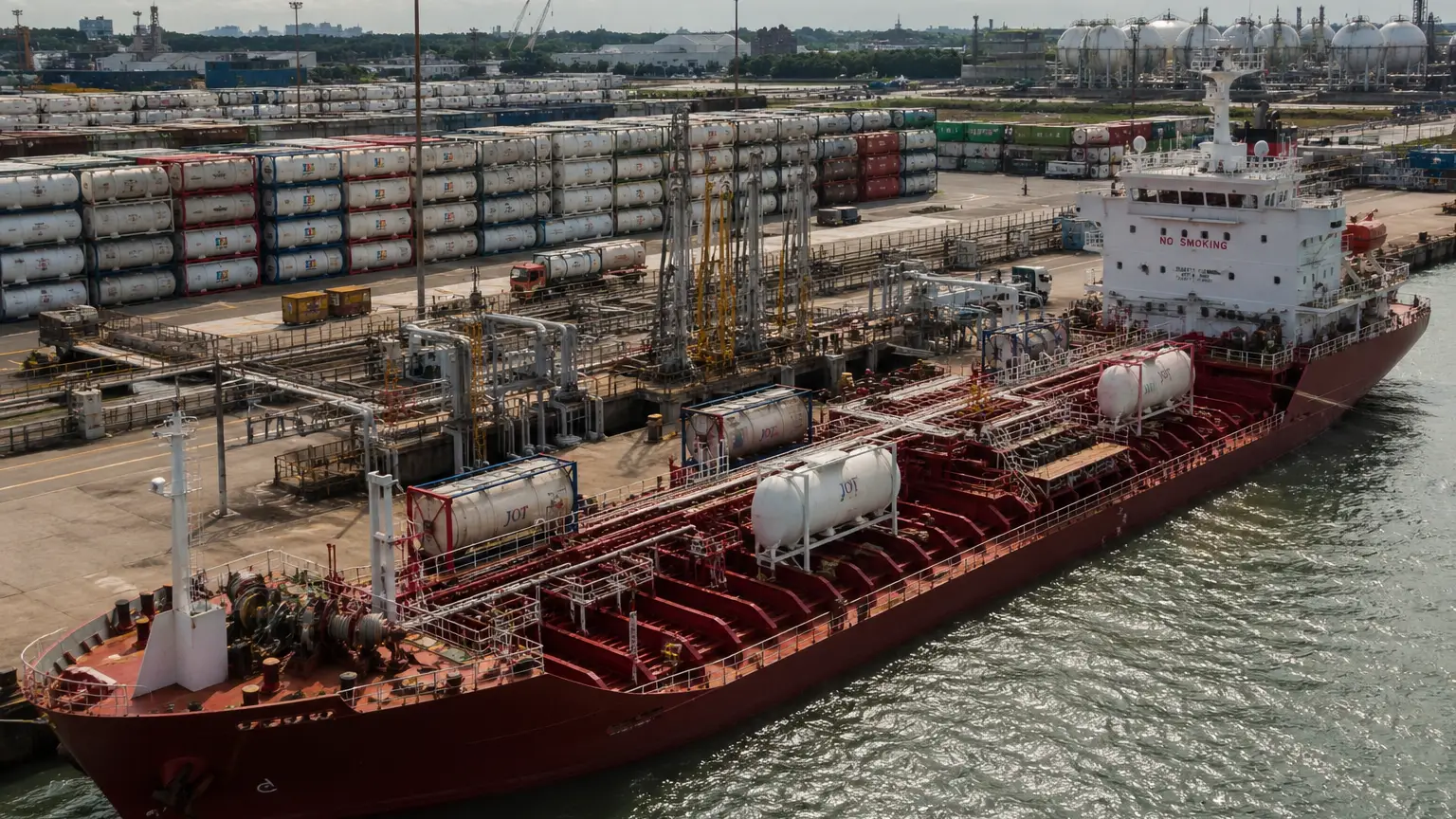
Production facilities are concentrated in Malaysia (Pasir Gudang, Lahad Datu corridors), Indonesia (Dumai, Belawan in North Sumatra), and to a lesser extent India. Refined lauric acid is shipped primarily from Pelabuhan Klang (Port Kelang), Tanjung Pelepas, and Dumai, typically via chemical tankers or ISO tank containers to receiving terminals in Rotterdam, Hamburg, Mumbai, and Los Angeles.
The geographic concentration matters because weather disruptions in the Philippines — where copra is grown — translate into feedstock disruptions for Malaysian and Indonesian oleochemical plants, not production disruptions at the plants themselves. A Malaysian producer like KLK OLEO operates its fractionation and distillation facilities in Malaysia, but its upstream feedstock sourcing is exposed to Philippine and Indonesian copra availability. This distinction matters: production doesn't shut down, but input costs rise and operating margins compress, which then passes through to finished lauric acid pricing.
2026 Price Outlook: Three Scenarios
Base Case: Firm H1, Gradual H2 Softening
Lauric acid prices are expected to remain elevated through Q2 2026, supported by residual Philippine supply constraints from the November 2025 typhoon damage and continued caution from producers about committing to lower contract prices before the harvest recovery picture clarifies. Indonesian production recovery and improving palm kernel oil availability from Malaysia provide a gradual floor-lowering dynamic from Q3 2026 onward.
In this base case, C12 lauric acid (99%) is expected to trade in the $1,650–$1,950/MT FOB Malaysia range in H2 2026, easing from the $1,800–$2,100/MT levels seen in Q1. CFR Western Europe delivered prices are expected to track proportionally, reflecting freight normalization from 2025's elevated container rates.
This is the most likely scenario absent new weather events in Southeast Asia.
Upside Risk: Secondary Climate Event Locks In 2026 Supply Deficit
A renewed typhoon strike on Philippine coconut-producing provinces (Quezon, Eastern Samar, Davao) during the June–November 2026 typhoon season, or a second-year La Niña episode suppressing Indonesian copra and PKO output, could push lauric acid prices back above $2,200/MT FOB Malaysia. The Philippine coconut tree population has no buffer capacity after the 2024 El Niño and November 2025 dual typhoon damage; a third consecutive climate shock would extend the structural supply deficit by another growing cycle.
A scenario of this type — which cannot be ruled out given the ENSO trajectory — would reduce the useful substitution window with PKO and could push high-purity lauric acid spot premiums above published index levels by 15–25% for on-spec material, as quality constraints compound physical scarcity.
Downside Risk: Early PKO Surplus + Demand Softness Overshoots Recovery
If Malaysian CPO and PKO production continues to outperform — particularly if Sabah avoids the monsoon-related harvest disruptions forecast by Helios AI through late 2025 and early 2026 — and if downstream demand from personal care, food emulsifier, and surfactant sectors remains subdued due to inventory destocking by major FMCG buyers, the market could soften faster than the base case. A scenario where C12 99% FOB Malaysia drops toward $1,450–$1,550/MT by Q4 2026 is plausible but requires both a strong Malaysian output year and meaningful demand compression.
This downside scenario is a tail risk, not a central view. Structural coconut supply constraints from the typhoon damage do not allow a significant oversupply scenario in lauric acid's dominant feedstock before late 2027 at the earliest.
| Scenario |
Price Range (C12 99%, FOB Malaysia) |
Key Trigger |
Probability Signal |
Timeframe |
| Base Case |
$1,650–$1,950/MT |
Indonesian PKO recovery; Philippine supply slowly stabilizing |
Most likely |
H2 2026 |
| Upside |
$2,000–$2,400/MT |
New typhoon or La Niña event in Philippine/Indonesian production zones |
Real risk |
Q3–Q4 2026 |
| Downside |
$1,450–$1,550/MT |
Strong Malaysian output + FMCG inventory destocking |
Tail risk |
Q4 2026 |
The balance of risk is skewed to the upside for H1 2026 and approaches balanced for H2. The typhoon season (June–November) is the single most important variable to monitor: it arrives before the supply recovery window and can reset the entire 2026 price trajectory within days of a landfall event in Quezon, Samar, or key Davao coconut provinces.
Frequently Asked Questions
What is lauric acid currently trading at in 2026?
Lauric acid (C12, 99% purity) was trading at approximately $1,800–$2,100/MT FOB Malaysia and $2,100–$2,400/MT CFR Western Europe in Q1 2026, according to Vesper price benchmarks and regional trade data. Prices have softened modestly from Q4 2025 peaks as Indonesian supply improved, but remain well above 2023 norms due to structural coconut supply constraints.
What are the main factors driving lauric acid prices in 2026?
Three named drivers are shaping the 2026 price environment. First, the compounding climate shock: the 2024 El Niño drought reduced Philippine and Indonesian coconut yields, followed by Super Typhoon Fung-Wong and Typhoon Kalmaegi in November 2025, which disrupted copra logistics, damaged trees, and degraded stored inventory quality. Second, the biological recovery lag: damaged coconut palms require five to nine years to return to productive capacity, meaning the supply deficit from the 2025 typhoons is not resolvable within a single crop year. Third, palm kernel oil partial substitution: stronger Malaysian CPO and PKO output is providing a price ceiling effect, but complete substitution is not possible for pharmaceutical-grade and high-purity cosmetic applications where C12 chain-length specifications are strict.
Is lauric acid price going up or down in 2026?
In the base case, prices are expected to ease modestly in H2 2026 relative to H1 as Indonesian PKO supply recovery progresses. The direction is softening, not a structural reversal. The key risk to this view is the 2026 typhoon season (June–November): a direct strike on Philippine coconut provinces would reset the supply recovery trajectory and push prices back toward or above Q4 2025 levels. Buyers should not wait for a sustained index decline before covering H2 volumes.
What is the best time of year to buy lauric acid?
Historically, the post-harvest period in Q1 (January–March) has offered the softest pricing as improved coconut availability reaches the market. However, the 2024–2026 climate disruption cycle has suppressed the typical Q1 seasonal relief. The window for moderately better pricing in the current cycle is more likely to appear in Q3–Q4 2026 if Indonesian production recovery materializes and no typhoon event occurs. Buyers should not rely on the pre-2024 seasonal pattern as a guide for 2026.
Should I buy lauric acid on a term contract or spot in 2026?
Term contracts are the preferred structure for at least 50–60% of H1 2026 requirements. The spot market carries quality premium risk that is not visible in published price indices — typhoon-affected copra has elevated contamination risk, meaning genuinely on-specification material commands premiums above benchmark levels. For H2 2026, a split structure (partial term, partial spot flexibility) is the rational approach, retaining upside protection against the typhoon season while preserving optionality if PKO supply drives a H2 softening scenario.
How does coconut oil price affect lauric acid price?
Coconut oil accounts for approximately 62% of global lauric acid feedstock, making it the primary cost driver. Lauric acid production cost moves in close correlation with crude coconut oil (CNO) prices, with a typical processing premium of 25–40% above CNO for refined 99% lauric acid. When CNO prices at CIF Rotterdam rose over 50% between October 2024 and October 2025, lauric acid indices followed within 4–8 weeks, reflecting the short refining lead time between CNO receipt and lauric acid delivery to downstream buyers.
Leave a Comment