
Introduction
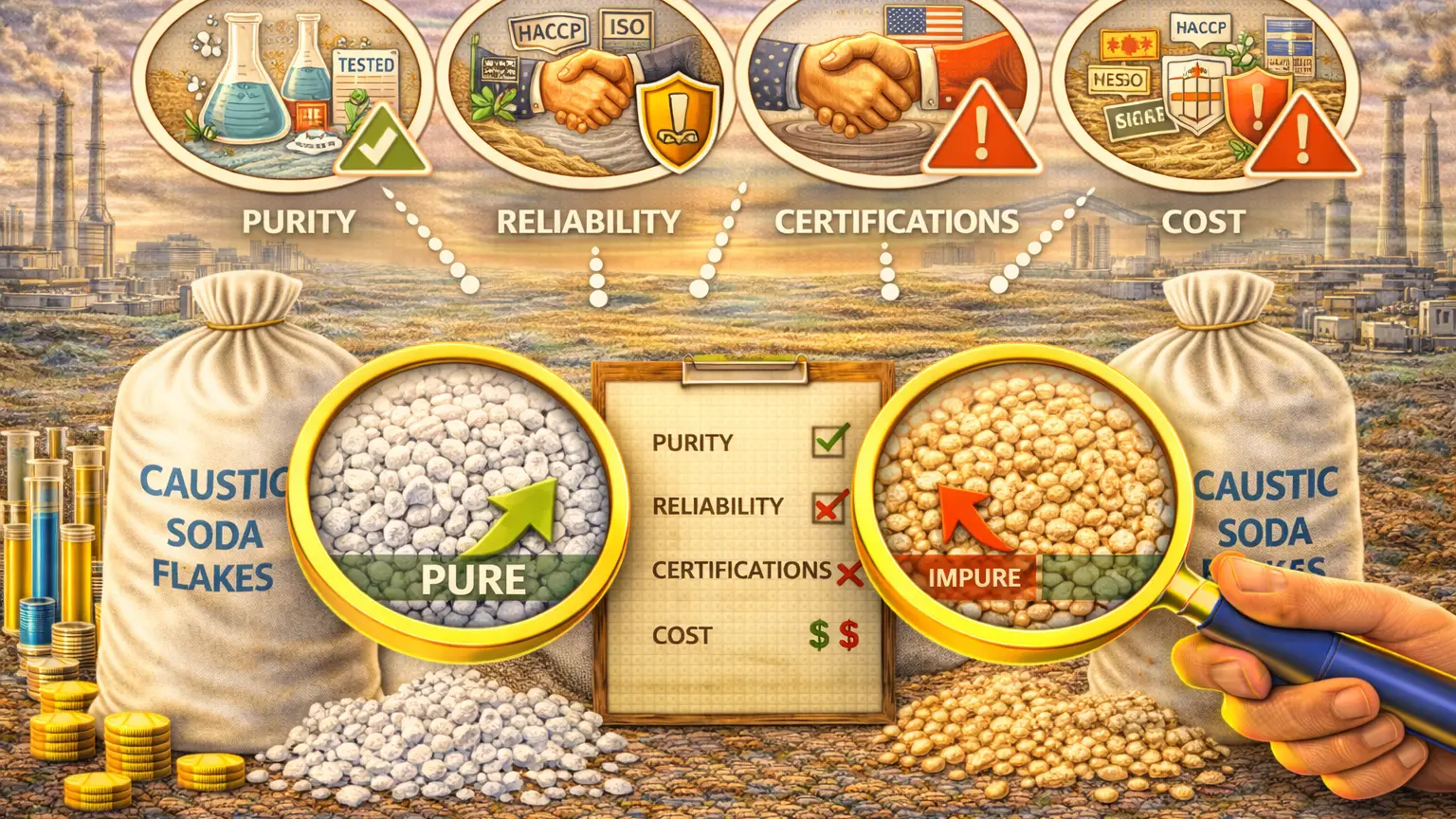
For American manufacturers in sectors such as pulp and paper, textiles, alumina, detergents, food processing, and water treatment, caustic soda flake (sodium hydroxide flakes) is a mission-critical raw material. A single disruption in supply can halt production lines, cause missed customer deliveries, and trigger expensive emergency purchases. Yet many buyers still rely on intuition, legacy relationships, or one-dimensional price comparisons when choosing between two caustic soda flake suppliers.
This article provides a structured, data-driven way to compare suppliers without guesswork. It lays out the technical, commercial, and operational criteria that matter most in the American market, and shows how digital sourcing platforms like chemtradeasia.com can simplify and de-risk the selection process. Whether you are sourcing a few pallets per month or multiple containers for multi-site operations, the same principles apply.
By the end, you will have a practical checklist and step-by-step framework you can apply immediately to evaluate two competing offers for caustic soda flake. The goal is not just to find the cheapest quote, but to secure the most reliable, compliant, and cost-effective long-term partner for your business in the United States.
Understanding Caustic Soda Flake and Its Market in America
Caustic soda flake is the solid, flaked form of sodium hydroxide (NaOH), typically produced from caustic soda prills or solidified molten caustic and then mechanically flaked. Commercial products are commonly available at 98–99% NaOH purity, with low levels of impurities such as sodium chloride (NaCl), sodium carbonate (Na2CO3), iron, and heavy metals. Because flakes are easier to handle, store, and dose compared with liquid caustic soda, they are widely used where dry handling or precise formulation control is needed.
In the American market, caustic soda demand is closely linked to construction, consumer goods, packaging, and energy trends. According to industry analyses, North America accounts for a significant share of global caustic soda consumption, with the United States being one of the largest producers and consumers. However, buyers still face price volatility driven by energy costs, chlorine co-product dynamics, and global trade flows. This volatility makes it essential to evaluate suppliers not only on price at a single point in time, but on their ability to offer stable, predictable supply contracts.
The U.S. regulatory environment also shapes how you should compare suppliers. Occupational Safety and Health Administration (OSHA) requirements, Department of Transportation (DOT) rules for hazardous materials, and Environmental Protection Agency (EPA) guidelines all influence packaging, labeling, transport, and storage of caustic soda flake. Suppliers that understand and comply with American regulations reduce your compliance risk. Platforms like chemtradeasia.com help by listing products with clear specifications, safety documentation, and origin details, enabling buyers in America to quickly screen for suitable options.
Key Quality and Safety Criteria When Comparing Suppliers
When you compare two caustic soda flake suppliers, the first layer of evaluation must be product quality and safety. At a minimum, you should request detailed technical data sheets (TDS) and certificates of analysis (COA) for recent batches. Key parameters to compare include NaOH purity (typically 98–99%), moisture content, carbonate content, chloride content, and heavy metal limits. Even small differences can matter for sensitive applications such as food processing, pharmaceuticals, or high-purity specialty chemicals.
Packaging and handling safety are equally important. Common packaging formats for caustic soda flake include 25 kg bags, 50 lb bags, and 1-tonne or 1,000 kg jumbo bags. When comparing suppliers, examine bag material (often polyethylene or polypropylene with inner liners), palletization method, and moisture barrier features. Poor packaging can lead to caking, dusting, or moisture absorption, which not only affects product performance but also increases handling hazards for your workforce. A supplier that offers robust, tested packaging solutions is often worth a modest price premium.
Safety documentation and compliance credentials should also be part of your comparison. Confirm that each supplier provides up-to-date Safety Data Sheets (SDS) compliant with the Globally Harmonized System (GHS) and U.S. OSHA Hazard Communication Standard. Look for evidence of ISO 9001 quality management certification and, where relevant, ISO 14001 environmental management. On platforms like chemtradeasia.com, many sellers list their certifications and regulatory compliance information, making it easier to filter out suppliers that cannot meet your internal EHS standards.
Pricing, Contracts, and Total Cost of Ownership
Price per ton or per pound is often the first number buyers compare, but it is only one component of the real cost of sourcing caustic soda flake. When evaluating two suppliers, you should look at total cost of ownership (TCO), which includes base price, freight, insurance, duties (for imports), storage, handling, and potential costs of supply disruptions. A supplier with a slightly higher unit price but more reliable lead times and fewer quality deviations may produce a lower overall cost for your operation.
Contract structure is another critical factor. In the American market, many buyers negotiate contracts indexed to energy prices, chlor-alkali market indices, or general chemical price benchmarks. When comparing two offers, examine whether pricing is fixed, formula-based, or subject to periodic review. Clarify minimum order quantities (MOQs), volume discounts, and any take-or-pay obligations. Through chemtradeasia.com, buyers can often request multiple quotations from different suppliers for equivalent caustic soda flake specifications, making it easier to benchmark pricing structures side by side.
Hidden and soft costs should not be ignored. These include administrative time spent resolving delivery issues, costs associated with non-conforming product (rework, disposal, production downtime), and the financial impact of delayed shipments. When you compare two caustic soda flake suppliers, ask for their historical on-time delivery rate, average lead time, and non-conformance rate. Suppliers that can demonstrate strong performance on these metrics, often documented through customer references or platform ratings on sites like chemtradeasia.com, typically deliver a lower TCO even if their headline price is not the lowest.
Evaluating Logistics, Reliability, and Service Performance
For buyers in America, logistics performance can be as important as technical quality. The geographic location of your supplier, their warehousing network, and their familiarity with U.S. transportation regulations all influence reliability. When comparing two suppliers, examine whether they maintain stock in U.S. ports or inland warehouses, their typical lead times to your facility, and their preferred transport modes (truckload, rail, intermodal). A supplier with regional stocking points may offer shorter and more predictable lead times than an overseas producer shipping only full containers.
Reliability should be evaluated using concrete indicators. Ask each supplier about their historical on-time in-full (OTIF) performance, contingency plans during port congestion or trucking shortages, and their approach to safety stock. In recent years, global supply chain disruptions have highlighted the importance of diversified sourcing and flexible logistics. Platforms like chemtradeasia.com allow you to identify multiple qualified sources of caustic soda flake, giving you options to switch or dual-source if one supplier faces unforeseen disruptions.
Customer service and technical support round out the comparison. Consider how quickly each supplier responds to RFQs, technical questions, and complaints. Evaluate whether they offer support with product trials, handling guidelines, and regulatory documentation. A supplier that provides proactive communication, clear shipment tracking, and rapid issue resolution can significantly reduce your internal workload. Some buyers in America use third-party platforms such as chemtradeasia.com to streamline communication, documentation exchange, and order tracking, thereby improving overall service performance across multiple suppliers.
How chemtradeasia.com Helps De-Risk Supplier Selection
chemtradeasia.com is an online B2B platform that connects buyers with vetted suppliers of industrial chemicals, including caustic soda flake. Instead of independently searching and qualifying each supplier, buyers can leverage the platform’s curated supplier base, product listings, and documentation to shorten their sourcing cycle. For American companies, this means access to both domestic and international producers and traders who are familiar with exporting to the U.S. market.
One advantage of using chemtradeasia.com when comparing two suppliers is the standardized way product information is presented. Listings for caustic soda flake typically include NaOH purity, packaging options, origin, minimum order quantity, and available certifications. This makes it easier to ensure you are comparing like with like—for example, 99% purity flakes in 25 kg bags from two different origins—rather than unintentionally mixing different grades or packaging formats. The platform can also support multiple quotations for the same specification, enabling transparent price benchmarking.
Additionally, chemtradeasia.com can help reduce transactional risk. By working through a recognized platform, buyers may benefit from clearer terms, structured communication, and assistance with international trade documentation. While each buyer remains responsible for their own due diligence and contract negotiation, the platform’s focus on industrial chemicals and long-term relationships provides an extra layer of confidence. For American purchasers who are exploring new overseas sources of caustic soda flake, this can be particularly valuable in mitigating the risks associated with unfamiliar suppliers, differing business practices, and complex logistics.
Practical Step-By-Step Framework to Compare Two Suppliers
To eliminate guesswork when choosing between two caustic soda flake suppliers, it is useful to apply a structured framework. The first step is to define your requirements clearly: target NaOH purity, acceptable impurity limits, packaging type and size, annual volume, delivery frequency, and delivery locations within America. Once these requirements are documented, you can issue a standardized request for quotation (RFQ) to both suppliers, ensuring that the information you receive is directly comparable. Tools and templates from sourcing platforms like chemtradeasia.com can help you structure these RFQs effectively.
Next, score each supplier across several weighted criteria: product quality and certifications, safety and compliance, price and contract terms, logistics performance, service responsiveness, and financial stability. For example, you might assign 30% weight to quality and safety, 25% to logistics and reliability, 25% to total cost, and 20% to service and support. Each supplier receives a score from 1 to 5 on each criterion based on the data you have collected—TDS/COA comparisons, delivery performance data, references, and proposal terms. This converts subjective impressions into a more objective, numerical comparison.
Finally, validate your preliminary decision with real-world tests and ongoing monitoring. If feasible, conduct a trial order from both suppliers and evaluate product performance in your process, packaging integrity upon arrival, and adherence to promised lead times. Incorporate feedback from production, quality, and EHS teams. Once you select a primary supplier, establish key performance indicators (KPIs) such as OTIF, non-conformance rate, and response time to inquiries, and review them regularly. Keeping a backup supplier in qualification—potentially identified via chemtradeasia.com—ensures you maintain leverage and resilience in your American supply chain for caustic soda flake.
Conclusion
Choosing between two caustic soda flake suppliers in America should never come down to guesswork or price alone. By systematically comparing technical quality, safety compliance, logistics capabilities, contract structures, and service performance, you can make decisions that protect your production continuity and reduce long-term costs. The most competitive option is often the supplier that delivers consistent quality and reliability at a fair price, rather than the lowest initial quote.
Digital sourcing platforms like chemtradeasia.com further support this process by providing transparent product information, access to multiple qualified suppliers, and tools to manage documentation and communication. For American buyers facing volatile markets and complex global supply chains, such platforms can be a strategic asset in building a robust and diversified sourcing strategy for caustic soda flake.
By applying the structured framework outlined in this article—clear specifications, weighted scoring, real-world trials, and ongoing performance monitoring—you can confidently compare two suppliers and select the partner that best aligns with your operational needs, risk tolerance, and growth plans. This disciplined approach transforms supplier selection from a reactive, ad-hoc process into a strategic capability that supports your competitiveness in the U.S. industrial landscape.