
Introduction Feather Meal
The global feed industry is undergoing a structural shift as it seeks to balance cost efficiency, nutritional performance, and sustainability. Within this context, Feather Meal has emerged as a critical high-protein ingredient used in poultry, aquaculture, and pet food formulations. As we approach 2026, understanding the end-to-end supply chain for feather meal is essential for feed manufacturers, traders, and integrators who must secure reliable sources of animal protein meals while meeting increasingly stringent regulatory and environmental requirements.
Feather meal is produced from poultry feathers, a by-product of the poultry slaughtering process, and is transformed through hydrolysis, drying, and grinding into a valuable feed ingredient. Its supply chain is closely tied to global poultry production hubs such as the United States, Brazil, China, and parts of Southeast Asia. This makes supply planning sensitive to shifts in poultry consumption, disease outbreaks, and regional trade dynamics. Market participants require both granular product knowledge and a robust logistics strategy to manage these risks.
International distributors and supply chain specialists such as chemtradeasia play an increasingly important role in connecting regional feather meal producers with feed manufacturers worldwide. By aggregating supply, standardizing quality specifications, and arranging cross-border logistics, these intermediaries help stabilize availability and pricing. This article examines the global feather meal supply chain for industry feed ingredients toward 2026, with a focus on market trends, product characteristics, logistics considerations, and strategic benefits for feed formulators.
Global Feather Meal Market Overview to 2026
Feather meal is part of the broader animal protein meals market, which also includes meat and bone meal, blood meal, and fish meal. According to industry analyses, the global animal feed market is projected to surpass USD 600 billion by the mid-2020s, driven by growth in poultry, swine, and aquaculture sectors. Feather meal, though a niche segment compared with soybean meal or corn, is expected to see steady demand growth in the low-to-mid single digits annually, supported by its high protein content and competitive cost per unit of digestible amino acids.
Production of feather meal correlates directly with poultry processing volumes. Major producing regions include North America (notably the United States), Latin America (Brazil and Argentina), Europe, China, India, and Southeast Asia. These regions host vertically integrated poultry operations where feathers are collected and processed into meal. As global poultry meat consumption continues to rise—driven by urbanization, income growth in emerging markets, and the relative affordability of poultry compared with red meat—the available raw material for feather meal is expected to increase, providing a stable base for supply expansion through 2026.
Trade flows in feather meal are shaped by regional surpluses and deficits. Countries with large poultry industries and advanced rendering capacity often become net exporters, while feed-deficit regions with expanding livestock sectors, such as parts of Africa, South Asia, and the Middle East, rely on imports. Supply chain partners like chemtradeasia help bridge these gaps by sourcing from multiple origins and offering consolidated shipments. Going into 2026, key market dynamics to watch include animal disease events (e.g., avian influenza), regulatory changes on animal by-product use in feed, and sustainability-driven procurement policies from multinational feed and food companies.
Product Profile: Feather Meal as a Strategic Feed Ingredient
Feather Meal is produced by hydrolyzing clean, undecomposed poultry feathers under high temperature and pressure, followed by drying and grinding. This process breaks down the keratin structure, increasing digestibility and making the protein accessible to monogastric animals and fish. Typical chemical specifications for commercial feather meal include crude protein levels in the range of 80–90%, low moisture (typically below 10%), and controlled fat content. Ash content and digestibility coefficients vary depending on processing conditions, making process control and quality assurance critical.
From a nutritional standpoint, feather meal is rich in certain amino acids such as cystine but relatively low in others like lysine and methionine, which means it is rarely used as a sole protein source. Instead, it is strategically incorporated into balanced feed formulations alongside soybean meal, canola meal, fish meal, or synthetic amino acids. When correctly formulated, feather meal can help reduce overall feed costs while maintaining or improving growth performance, feed conversion ratios, and carcass quality in poultry and aquaculture species.
Commercial buyers typically evaluate feather meal based on a set of standardized parameters: crude protein percentage, pepsin digestibility or in vitro digestibility measures, microbiological status (including Salmonella and total plate counts), particle size, and color/odor as indicators of processing quality. Suppliers and distributors such as chemtradeasia increasingly provide detailed certificates of analysis (COAs), batch traceability, and compliance documentation aligned with ISO, HACCP, and local regulatory requirements. This level of transparency is becoming a prerequisite for multinational feed producers and integrators operating in highly regulated markets.
Supply Chain Dynamics and Logistics for Feather Meal
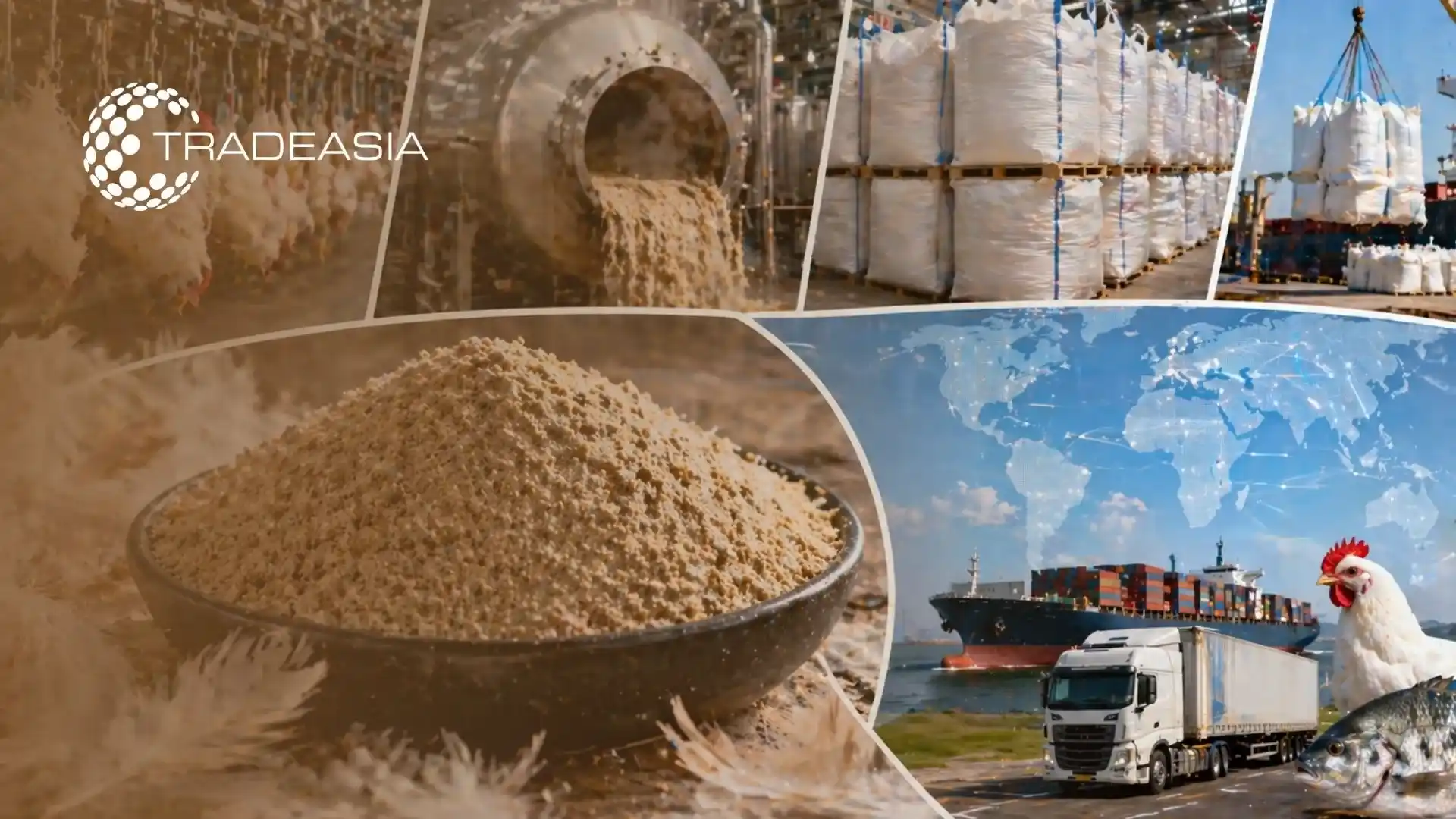
The feather meal supply chain begins at poultry processing plants, where feathers are collected, screened for contaminants, and transferred to rendering or specialized hydrolysis facilities. Timely handling at this stage is essential to prevent microbial growth and quality degradation. After hydrolysis and drying, the product is milled, cooled, and stored in silos or bags. Proper storage conditions, including low humidity and controlled temperature, help preserve nutrient value and prevent caking or rancidity.
Logistics for feather meal involve both domestic transport from rendering plants to ports or local feed mills and international shipping for export markets. The product is typically shipped in bulk, jumbo bags, or 25–50 kg bags, depending on the buyer’s infrastructure and handling capabilities. Ocean freight remains the dominant mode for long-distance trade, with major export routes connecting Brazil and the United States to Asia, the Middle East, and Africa. Freight rate volatility, port congestion, and container availability have become more prominent risk factors since 2020, prompting many buyers to seek diversified sourcing and flexible shipment terms.
Supply chain partners like chemtradeasia add value by coordinating multi-origin sourcing, optimizing shipment sizes, and managing documentation for customs and sanitary approvals. This includes veterinary health certificates, country-specific import permits, and compliance with regulations such as the European Union’s rules on animal by-products or local feed safety laws in Asia and Latin America. In anticipation of 2026, digitalization of trade documentation, enhanced traceability systems, and closer collaboration between producers, traders, and feed manufacturers are expected to improve supply chain resilience and visibility for feather meal.
Benefits and Strategic Applications in Industrial Feed Formulations
The primary benefit of Feather Meal in industrial feed formulations is its high crude protein content, which can exceed 80% on a dry matter basis. This makes feather meal an attractive option for feed formulators seeking to increase protein density without proportionally increasing feed cost. When used judiciously, feather meal can partially replace more expensive protein sources such as fish meal or soybean meal, especially in poultry and fish diets where specific amino acid imbalances can be corrected with complementary ingredients or synthetic amino acids.
Another strategic advantage is the contribution of feather meal to circular economy objectives. By valorizing poultry feathers that would otherwise be disposed of as waste, the rendering and feed industries reduce landfill burden, mitigate greenhouse gas emissions associated with waste decomposition, and improve overall resource efficiency. Many feed and food companies have adopted sustainability metrics that favor by-product utilization, and the inclusion of feather meal in feed portfolios supports these corporate commitments. Suppliers like chemtradeasia increasingly highlight the environmental benefits of such ingredients in their product offerings and sustainability reporting.
In terms of applications, feather meal is commonly used in broiler, layer, and turkey feeds at inclusion levels typically ranging from 2% to 5%, depending on local regulations, species, and formulation objectives. In aquaculture, it may be used in certain fish and shrimp diets as a partial replacement for fish meal, provided that digestibility and palatability are adequately managed. It also appears in some pet food formulations, particularly in value-oriented products, where it contributes protein and supports cost competitiveness. Across these applications, consistent quality, reliable supply, and transparent specification data—often facilitated by international suppliers such as chemtradeasia—are crucial for successful integration into industrial feed programs.
Conclusion
As the global feed industry moves toward 2026, feather meal is poised to maintain and potentially expand its role as a cost-effective, protein-rich ingredient that supports both performance and sustainability objectives. The close linkage between feather meal availability and poultry production provides a relatively stable raw material base, while advances in rendering technology and quality control enhance product consistency and safety. Market participants who understand these dynamics will be better positioned to capture value and mitigate risk in their feed ingredient portfolios.
The supply chain for feather meal, however, is not without challenges. Geopolitical tensions, disease outbreaks, freight disruptions, and evolving regulatory frameworks all have the potential to affect trade flows and pricing. Strategic sourcing partnerships, multi-origin procurement, and robust logistics planning are therefore essential. International distributors like chemtradeasia can help feed manufacturers navigate this complexity by offering diversified sourcing options, standardized specifications, and end-to-end documentation support, thus enabling more resilient and transparent supply chains.
This article is intended solely for informational and market insight purposes and does not constitute technical, safety, formulation, or other professional advice. Readers should independently verify all information with qualified experts, consult official documentation such as MSDS/SDS and relevant regulations, and contact appropriate professionals or our team before making decisions or using Feather Meal or any related products in specific applications.