Borax pentahydrate (Na₂B₄O₇·5H₂O) for fiberglass applications is overwhelmingly sourced from two origins — Turkey, which controls over 70% of global borate reserves through state-owned Eti Maden, and the United States, where Rio Tinto Borates accounts for approximately 30% of global refined supply. Asia-Pacific buyers, who represent roughly 39–48% of global demand, receive material primarily via bulk dry cargo vessels through the Strait of Malacca, with India's Hazira and Mundra ports serving as the primary entry points for the subcontinent. Concentration in a single-country reserve base, the 2026 closure of Searles Valley Minerals in North America, and persistent Indian Ocean freight volatility make this supply chain structurally tighter than most buyers currently price into their procurement plans.
What Borax Pentahydrate Does in Fiberglass and Why That Makes It Irreplaceable
Borax pentahydrate is not interchangeable with other boron compounds in high-performance fiberglass manufacturing. Its boric oxide (B₂O₃) content of approximately 47–48% is significantly higher than borax decahydrate, meaning 74.6 pounds of pentahydrate delivers the same active boron as 100 pounds of decahydrate. For fiberglass producers running high-volume continuous melting furnaces, that efficiency difference is directly reflected in batch formulation costs and furnace energy consumption.
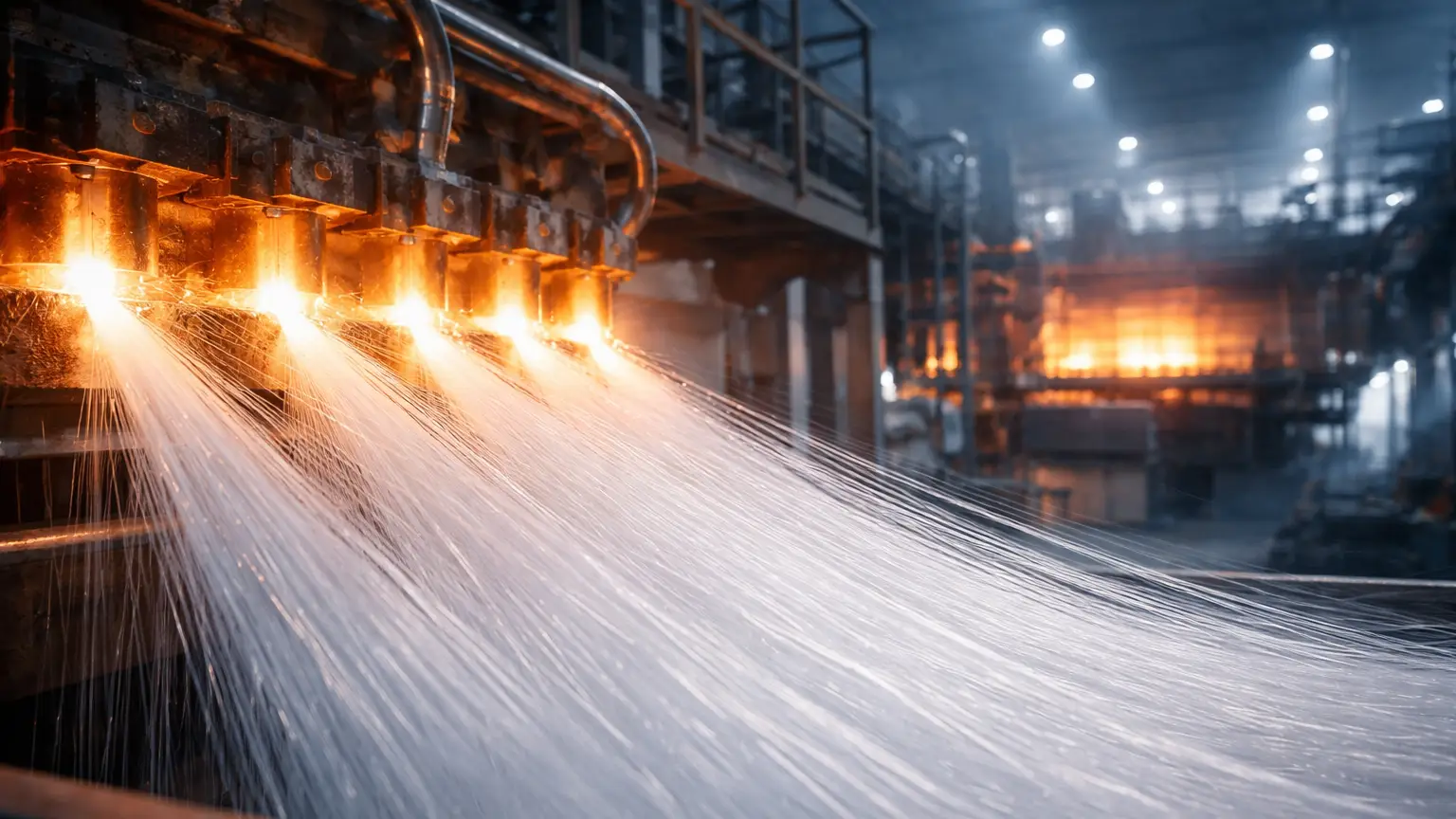
In the melt, borax pentahydrate functions as a flux: it lowers the liquidus temperature of the silica-alumina glass batch, reduces melt viscosity to allow fiber drawing at lower temperatures, and raises the glass's chemical resistance and mechanical durability. The reduction in clinkering temperature, the point at which batch ingredients begin to coalesce without melting is a direct energy-saving mechanism. For fiberglass insulation producers in China, India, and Southeast Asia, where energy input costs represent a significant share of conversion costs, this functional property of boron makes pentahydrate a lever on production economics, not merely a raw material input.
Textile-grade fiberglass consumes approximately 35% boric acid (or its borax equivalent) in its glass batch by boric oxide content. Borosilicate glass, widely used in electronics and specialty construction glass, runs higher. For insulation-grade E-glass, which dominates the Asia-Pacific fiberglass insulation market, typical B₂O₃ content in the final glass runs between 5–9%, requiring consistent, high-purity borax pentahydrate input to maintain product homogeneity across production batches.
The purity threshold matters here. Fiberglass and ceramics applications require low heavy metal content — particularly iron oxide, which causes color defects and weakens glass fibers. This specification requirement limits the pool of acceptable suppliers. Industrial-grade pentahydrate with relaxed heavy metal tolerances, which is adequate for detergent or agricultural applications, is not directly substitutable in fiberglass production without quality validation.
Where Borax Pentahydrate Is Produced: A Supply Chain Defined by Reserve Geography
| Origin |
Reserve Share (Global) |
Refined Supply Share (Global) |
Key Producer |
Export Destinations in APAC |
| Turkey |
~73% |
~50–55% |
Eti Maden (state-owned) |
India, China, Southeast Asia |
| United States |
~8–10% |
~25–30% |
Rio Tinto Borates (Boron, CA) |
Japan, Australia, East Asia |
| South America |
~10% |
~10–12% |
Quiborax (Chile), Borax Argentina |
Regional, limited APAC export |
| China |
Marginal |
~5–8% domestic |
Fangyuan Boron Chemical |
Primarily domestic consumption |
| India |
Marginal |
Negligible |
Various small processors |
Domestic only, net importer |
Turkey: The Reserve Monopoly That Sets the Price Floor
Turkey controls the world's largest borate deposits. Its state-owned mining and chemicals enterprise, Eti Maden, operates refining facilities at Bandırma on the Sea of Marmara, which produce approximately 400,000 tonnes of refined boron products per year across its full product range : borax pentahydrate, borax decahydrate, boric acid, anhydrous borax, and specialty compounds. Eti Maden's APAC sales are managed through a dedicated regional entity, Etimaden Asia Pacific Limited, with an exclusive sales territory covering China, Vietnam, the Philippines, Indonesia, Thailand, Singapore, Malaysia, Sri Lanka, Bangladesh, and several other regional markets.
Turkey's competitive advantage is structural: subsidized domestic energy, low-cost mine extraction, and a government mandate to develop value-added boron exports. Eti Maden has publicly targeted USD 5 billion in annual borate exports, a goal that depends on continued growth in Asia-Pacific demand, particularly from fiberglass, solar glass, and electronics manufacturing. For APAC buyers, this means Turkey is simultaneously the price setter and the volume backstop. When Turkish FOB offers rise as they did by approximately 8% in Q4 2025, driven by export demand from India and restocking in European markets
Rio Tinto Borates: The High-Cost Alternative That Matters Most Under Stress
Rio Tinto's Boron mine in Kern County, California operates on a significantly higher cost base than Eti Maden. Regulatory compliance, labor, and environmental standards in California push operating costs well above Turkish levels, creating a persistent FOB price differential. Yet Rio Tinto Borates serves a structural function in the APAC supply chain: it absorbs incremental demand when Turkish allocations tighten, and its high-purity refined grades carry quality premiums that fiberglass manufacturers and borosilicate glass producers in Japan, South Korea, and Australia specifically seek.
The significance of the 2026 closure of Searles Valley Minerals' California operations is not negligible. Searles Valley was a secondary U.S. borate producer whose exit has reduced North American supply flexibility, tightened exportable surplus from the U.S. origin, and pushed more Asian demand volume toward direct Turkish sourcing. For APAC buyers who had maintained U.S.-origin supplies as a secondary source, the practical pool of reliable origin alternatives has narrowed.
China and India: Growing Consumers, Not Meaningful Producers
China's Fangyuan Boron Chemical Industry Co. has expanded domestic borax production, but Chinese domestic output is absorbed internally by the country's own ceramics, glass, and electronics sectors. China remains a net importer of high-grade refined borates despite its production footprint. India has negligible refining capacity for borax pentahydrate and is structurally dependent on imports, with demand continuing to accelerate. In Q4 2025, India's Borax Pentahydrate price index reached approximately USD 1,047/MT — a 8.35% quarter-over-quarter increase driven by higher FOB offers from Turkey and the U.S., thin distributor inventories at Hazira and Mundra, and pre-season stocking by ceramics and fiberglass producers.
How Borax Pentahydrate Moves to Asia-Pacific Fiberglass Producers
Primary Transport Mode: Bulk Dry Cargo and Bagged Container
Borax pentahydrate for industrial fiberglass applications typically moves in one of two formats: bulk dry cargo (for large-volume buyers with appropriate unloading infrastructure) and bagged product in 25 kg or 1,000 kg bulk bags loaded into standard 20-foot containers. Most APAC fiberglass producers operating mid-to-large scale plants prefer bagged-container delivery, which provides easier inventory control, reduced moisture ingress risk during handling, and compatibility with standard warehouse systems.
The hygroscopic nature of borax pentahydrate — it absorbs moisture from ambient air, risking caking and product degradation — creates non-trivial handling requirements across the logistics chain. Climate-controlled storage is recommended in tropical locations including Indonesia, Vietnam, Thailand, and coastal India. Port dwell times in high-humidity environments extend the degradation window, which argues for direct dispatch rather than extended port transshipment.
Key Trade Route: Bandırma/Mersin → Strait of Malacca → Indian Subcontinent and Southeast Asia
From Eti Maden's Bandırma facility, product typically moves via feeder vessel to transshipment ports (often via Port Said or direct to Colombo), then onward to final destinations in India (Mundra, Hazira, JNPT), China (Shanghai, Tianjin), and Southeast Asia (Port Klang, Singapore, Ho Chi Minh City). The Strait of Malacca is the primary maritime chokepoint for all APAC borax pentahydrate flows from both Turkish and U.S. origins.
| Trade Lane |
Approximate Transit Time |
Primary Port Pairs |
Risk Level |
| Bandırma → Mundra (India) |
18–25 days |
Bandırma / Mersin → Mundra / Hazira |
Medium (Red Sea rerouting) |
| Bandırma → Shanghai |
28–35 days |
Bandırma → Shanghai / Tianjin |
Medium |
| Los Angeles → Yokohama (Japan) |
14–18 days |
LA / Long Beach → Yokohama / Nagoya |
Low–Medium |
| Bandırma → Singapore / Port Klang |
22–30 days |
Bandırma → Port Klang / Singapore |
Medium |
| Bandırma → Ho Chi Minh City |
24–32 days |
Bandırma → HCMC / Da Nang |
Medium |
Maritime Chokepoints and 2025 Freight Disruption Legacy
Red Sea vessel attacks in 2024–2025 forced major carriers including COSCO and MSC to reroute Turkish-origin shipments around the Cape of Good Hope, adding 10–21 days to transit times and increasing freight rates by up to 300% on certain Turkey-to-Asia lanes. By late 2025, peak disruption had eased but had not normalized — and the legacy impact was embedded in shipper behavior. Buyers who absorbed spot freight cost spikes (from a baseline near USD 1,800 to over USD 6,000 on some Asia–Europe corridors) are now structuring supply agreements with freight cost indexation clauses and longer advance order windows.
For borax pentahydrate specifically, the freight disruption compressed already-thin spot availability. Exporters who curtailed year-end 2025 shipments under deteriorating freight economics reduced Q1 2026 inventory at Indian ports below comfortable buffer levels. Buyers relying on spot procurement at Hazira and Mundra discovered that thinned inventories and higher FOB offers compounded simultaneously. The worst combination for unhedged procurement teams.
Borax Pentahydrate Supply Risk Assessment for Asia-Pacific Fiberglass Buyers
| Risk Dimension |
Rating |
Primary Driver |
Historical Precedent |
| Concentration Risk |
HIGH |
>70% of reserves held by one country |
Turkey alone determines global pricing trajectory |
| Geopolitical Risk |
MEDIUM–HIGH |
Turkish state monopoly, U.S. supply contraction |
Searles Valley closure, 2026 |
| Logistics Risk |
MEDIUM–HIGH |
Red Sea rerouting, APAC port congestion |
2024–25 freight rate spike (+300% on some lanes) |
| Structural Risk |
MEDIUM |
APAC demand outpacing secondary supply additions |
India import price: USD 1,047/MT in Q4 2025 |
| Pricing Volatility |
HIGH |
Feedstock and energy costs + logistics |
APAC price index up 8.35% in one quarter, late 2025 |
Concentration Risk: HIGH
Over 70% of the world's known borate reserves sit in Turkey. No other country has deposits of comparable grade or scale currently under development. This means the global pricing floor for borax pentahydrate is functionally set by Eti Maden's production cost, capacity allocation, and export strategy. When Turkey raises FOB offers — whether due to domestic energy costs, export demand competition between European and Asian buyers, or government pricing direction — APAC buyers have no equivalent alternative volume to absorb the difference. Secondary suppliers (Rio Tinto, Quiborax) can provide partial relief, but not at a scale that balances a major Turkish allocation reduction.
Geopolitical Risk: MEDIUM–HIGH
Eti Maden is a state-owned enterprise operating under Turkish government policy. Turkey has used its borate monopoly to upgrade from raw ore exports to refined product exports — a strategy that has generally increased supply consistency, but which also means pricing and export volume decisions involve government-level considerations beyond commercial market dynamics. The U.S. and EU have both designated boron as a critical mineral, and strategic stockpiling initiatives under programs like "Project Vault" reflect growing government concern about supply concentration. For APAC fiberglass producers, geopolitical risk at the supply origin is not a remote scenario — it is structurally embedded in a supply chain where one state-owned entity controls the largest reserves on earth.
Logistics Risk: MEDIUM–HIGH
The Red Sea disruption demonstrated how quickly borax pentahydrate transit times and freight costs can double from a single geopolitical shock in a maritime corridor thousands of miles from the producing country. Indian Ocean routing remains sensitive. For fiberglass manufacturers in India, Vietnam, and Indonesia with tight just-in-time batch scheduling, a 10-day transit time extension is not an operational inconvenience — it directly impacts production scheduling and can trigger unplanned shutdowns.
What Drives Borax Pentahydrate Prices for APAC Fiberglass Buyers
Feedstock: Tincal Ore and Sodium Tetraborate
The pricing foundation for borax pentahydrate is tincal ore (natural sodium borate) and, for re-refined product, sodium tetraborate. Products are priced by boric oxide (B₂O₃) content, so feedstock grade fluctuations transmit directly into refined product pricing. When upstream sodium tetraborate offers firmed in late 2025, the APAC pricing index moved upward in parallel, with Indian buyers particularly exposed given their dependence on imported feedstocks. Light soda ash is a secondary input in some refining routes; North American soda ash price stability through much of 2025 helped moderate U.S.-origin pricing pressure, while Turkish energy cost increases pushed in the opposite direction.
Energy: The Refining Cost Multiplier
Borax pentahydrate production requires high-temperature calcination and crystallization processes that are energy-intensive. In Turkey, natural gas tariff increases during winter months — standard in European gas markets — translate directly into higher FOB costs. Eti Maden's cost structure, while lower than U.S. producers, is not immune to European energy volatility. Rising diesel and energy costs in North America contributed to a 5.2% price increase in U.S.-origin borax pentahydrate in 2025. For APAC buyers modelling 2026 landed costs, energy policy developments in Turkey and the U.S. are a primary variable, not background noise.
APAC Demand Acceleration: The Structural Tightening Force
Asia-Pacific accounts for approximately 39–48% of global borax pentahydrate demand. The fiberglass segment represents the dominant application driver within that demand base, with construction-grade fiberglass insulation consumption growing in direct proportion to Asia's urbanization rate and the tightening of energy efficiency building codes across China, India, Indonesia, and Vietnam. The construction insulation market is projected to expand at roughly 4.2% annually through 2030, and fiberglass holds a dominant material position within that growth trajectory.
China and India are expanding solar glass production to meet domestic photovoltaic targets, creating additional demand that competes directly with fiberglass applications for available borax pentahydrate supply. India's Borosil Renewables is increasing solar glass capacity under government production-linked incentive schemes. China's "Made in China 2025" initiatives prioritize advanced glass and electronics manufacturing. These demand vectors are not cyclical — they are policy-driven and structurally persistent.
In Q4 2025, Indian borax pentahydrate spot prices reached USD 1,047/MT on a landed basis. Turkish FOB prices stood at approximately USD 603/MT. The gap between origin and destination — nearly USD 444/MT — reflects freight costs, distributor margin, port handling, and import logistics at Hazira and Mundra. Any significant compression in freight availability or increase in Turkish export offers immediately widens this gap further.
Asia-Pacific Fiberglass Demand for Borax Pentahydrate: The 2026 Growth Map
| Country / Region |
Primary Demand Driver |
Fiberglass Application |
Growth Signal |
| China |
Solar glass, electronics, automotive |
E-glass, borosilicate glass |
Stable–moderate (domestic production offsetting some imports) |
| India |
Infrastructure construction, PLI manufacturing |
Insulation fiberglass, FRP |
HIGH — fastest-growing import market |
| Indonesia |
Urban development, export manufacturing |
Insulation, ceramics |
MEDIUM–HIGH — infrastructure boom |
| Vietnam |
Electronics FDI, construction |
FRP, insulation |
HIGH — electronics supply chain expansion |
| Philippines |
Transport, urban infrastructure |
Fiberglass insulation |
MEDIUM |
| Japan / South Korea |
High-tech glass, electronics |
Borosilicate, specialty glass |
STABLE — mature, quality-focused |
| Australia |
Construction, energy infrastructure |
Insulation, industrial glass |
STABLE–LOW growth |
India stands as the single most important growth market for APAC borax pentahydrate procurement strategy. India remains a net importer without meaningful domestic refining capacity, while its fiberglass insulation demand is accelerating on the back of construction activity, government manufacturing incentives, and increasingly strict energy performance standards in commercial building codes. Saint-Gobain's acquisition of UP Twiga Fiberglass Ltd. in India signals how seriously multinational fiberglass producers are treating the Indian growth trajectory — and how much refined borates those new capacity additions will require.
Southeast Asia, specifically Indonesia, Vietnam, and the Philippines, represents the emerging demand frontier. Foreign direct investment in electronics assembly (Vietnam), automotive components (Thailand, Indonesia), and large-scale infrastructure (Philippines) is drawing fiberglass consumption upward at compound annual rates exceeding 5–7% in the most active countries.
How Asia-Pacific Buyers Procure Borax Pentahydrate for Fiberglass: Channels and Strategy
Procurement Channel Options
Asia-Pacific fiberglass manufacturers access borax pentahydrate through three primary channels:
Direct from Producer (Eti Maden / Rio Tinto): Available for large-volume buyers meeting minimum order thresholds, typically 200–500 MT per shipment. Eti Maden's APAC entity, Etimaden Asia Pacific, manages direct relationships across China, Southeast Asia, and certain other markets. India and surrounding South Asian countries are served by separate Eti Maden sales arrangements. Direct procurement provides first access to allocation and price negotiation leverage, but requires buyers to manage ocean freight, customs, and port logistics independently.
Regional Chemical Distributors: Distributors operating in India (at Hazira, Mundra, and JNPT), Singapore, and Malaysia maintain warehoused inventory that enables smaller order quantities, faster delivery, and local currency pricing. Regional distributors absorb freight risk and often provide just-in-time delivery to fiberglass plant gates. The trade-off is price premium (typically 8–15% above direct-import landed cost) and limited transparency on origin lot traceability.
Trading Companies: International chemical traders — often Singapore-based — aggregate purchases from multiple origins (Turkey, U.S., South America) and sell on CFR or DAP terms into APAC markets. For buyers requiring origin flexibility, traders offer the broadest optionality, though allocation security during tight markets is lower than with direct producer relationships.
Contract vs. Spot — Decision Framework for Fiberglass Producers
For fiberglass insulation manufacturers with stable monthly consumption volumes above 50 MT, term contracts with quarterly or semi-annual price reviews are the structurally lower-risk procurement model in 2026. Spot procurement in the APAC borax pentahydrate market exposes buyers to two simultaneous risks: Turkish origin FOB price spikes (driven by global demand competition) and freight cost volatility on the Turkey-to-Asia corridor. When both move adversely at the same time — as occurred in Q4 2025 — spot buyers face landed cost increases of 12–20% within a single quarter with no forward visibility.
Term contracts do not eliminate price exposure, but they do provide allocation security and typically allow price adjustments against agreed indexation mechanisms tied to published benchmarks (ICIS, Chemanalyst, or Argus Media price assessments) rather than spot market moves. For buyers in India where the spot-to-delivered gap is already USD 400+ per MT, even a modest freight protection mechanism in a term contract structure is financially meaningful.
Origin Diversification Strategy
Buyers currently sourcing exclusively from Turkish origin via single distributor relationships carry concentration risk that is not commensurate with the strategic role borax pentahydrate plays in fiberglass batch formulation. A practical diversification strategy for mid-to-large APAC fiberglass producers involves maintaining a primary Turkish-origin term contract for base volume (70–80% of annual requirement), supplemented by a secondary U.S.-origin or South American supply relationship for 20–30% of volume. The quality premium on Rio Tinto Borates' high-purity grades is justified for fiberglass applications requiring tighter iron oxide specifications.
Inventory and Buffer Stock
Given current transit times of 18–35 days from Turkish origin to major APAC receiving ports, a minimum 45–60 days of on-site buffer stock is a defensible baseline for fiberglass producers operating continuous melting operations. The 2025 Red Sea rerouting experience demonstrated that transit time extensions of 15–21 days are operationally realistic, and that inventory drawdowns in APAC distributor networks during freight disruption events leave spot buyers without available volume regardless of willingness to pay.
Borax pentahydrate's hygroscopic character caps practical storage duration under tropical conditions at approximately 6 months with adequate packaging and climate control. A 45–60 day operational buffer is therefore both commercially practical and technically achievable without product degradation risk.
Conclusion
The borax pentahydrate supply chain for Asia-Pacific fiberglass applications in 2026 is tighter than it appears from headline market commentary. Three structural conditions are converging simultaneously: the exit of a secondary North American producer (Searles Valley Minerals) reducing global supply optionality, accelerating APAC demand from construction fiberglass, solar glass, and electronics-grade borosilicate applications, and persistent freight route volatility on the primary Turkey-to-Asia lane. India's borax pentahydrate landed price reached USD 1,047/MT in Q4 2025 — a level that reflects what happens when supply concentration, freight disruption, and demand growth reach an inflection simultaneously.
Buyer Action Steps for 2026:
- Audit current procurement structure: if more than 70% of annual borax pentahydrate volume is sourced spot through a single regional distributor, that exposure needs to be restructured before Q3 2026 demand peaks.
- Establish or renew term contracts with price indexation clauses — indexed to ICIS or Chemanalyst APAC borax pentahydrate assessments — for at least 60% of annualized volume.
- Add a secondary origin to the approved supplier list: either Rio Tinto Borates for high-purity grades or a South American origin via trading desk for cost flexibility.
- Build minimum 45-day on-site buffer stock, and treat this as a fixed operating requirement rather than a cost-to-be-optimized.
- Monitor Eti Maden allocation signals and Turkish export demand from European buyers — when European restocking competes with APAC allocation, FOB prices firm quickly and APAC buyers absorb the impact within one shipment cycle.
For APAC fiberglass producers where borax pentahydrate is a non-substitutable batch input, procurement risk management for this material deserves the same attention as silica sand or alumina. The market is small by bulk chemical standards, but the supply chain is concentrated, the demand growth is real, and the cost of an unplanned production disruption far exceeds the cost of a structured procurement approach.
Frequently Asked Questions
Q: Who are the largest producers of borax pentahydrate globally?
Eti Maden, Turkey's state-owned mining enterprise, is the dominant global producer, controlling over 70% of known borate reserves and supplying approximately 50–55% of refined borax pentahydrate to global markets. Rio Tinto Borates, operating the Boron mine in Kern County, California, accounts for approximately 25–30% of global supply. South American producers Quiborax (Chile) and Borax Argentina collectively hold around 10–12% of global refined capacity.
Q: How is borax pentahydrate transported to Asia-Pacific fiberglass manufacturers?
Borax pentahydrate from Turkey ships from Bandırma or Mersin, typically in bagged containers via general cargo or conventional vessel, routed through the Strait of Malacca to Indian ports (Mundra, Hazira, JNPT) and Southeast Asian hubs (Port Klang, Singapore). Transit from Turkey to India runs 18–25 days under normal conditions; Red Sea disruption events have extended this to 35–40 days via Cape of Good Hope rerouting. U.S.-origin product from Los Angeles reaches Japan and Australia in 14–18 days.
Q: What factors drive borax pentahydrate prices in Asia-Pacific?
APAC borax pentahydrate prices are primarily driven by Turkish FOB offers (set by Eti Maden's production costs, including energy), ocean freight rates on Turkey-to-Asia lanes, and upstream sodium tetraborate feedstock costs. Local demand from ceramics, solar glass, and fiberglass insulation sectors applies seasonal tightening pressure, particularly in Q1 (pre-season ceramics stocking) and Q4 (pre-production restocking). In Q4 2025, Indian landed prices reached USD 1,047/MT, a quarterly increase of 8.35%.
Q: What are the main supply chain risks for borax pentahydrate buyers in Asia-Pacific?
The primary risk is supply concentration: over 70% of global reserves are in Turkey, controlled by a single state-owned entity. Any disruption to Eti Maden's production, or export reallocation toward European buyers competing for the same supply, reduces APAC availability with no equivalent secondary source to absorb the volume gap. Secondary risk is logistics exposure on the Turkey-Asia corridor — Red Sea rerouting in 2024–2025 extended transit times by 10–21 days and increased freight costs by up to 300% on some lanes.
Q: How do fiberglass producers in Asia-Pacific typically structure borax pentahydrate procurement?
Large-volume producers (annual requirements above 500 MT) maintain direct term contracts with Eti Maden's APAC sales entity or Rio Tinto Borates, typically with quarterly price adjustments indexed to published market benchmarks. Mid-sized producers more commonly source via regional distributors in India and Singapore, which carry inventory and offer smaller order flexibility. Best-practice procurement includes a secondary origin relationship, 45–60 days of on-site buffer stock, and freight cost protection embedded in contract terms.
Leave a Comment